SNAP OR STRING BEAN WINE
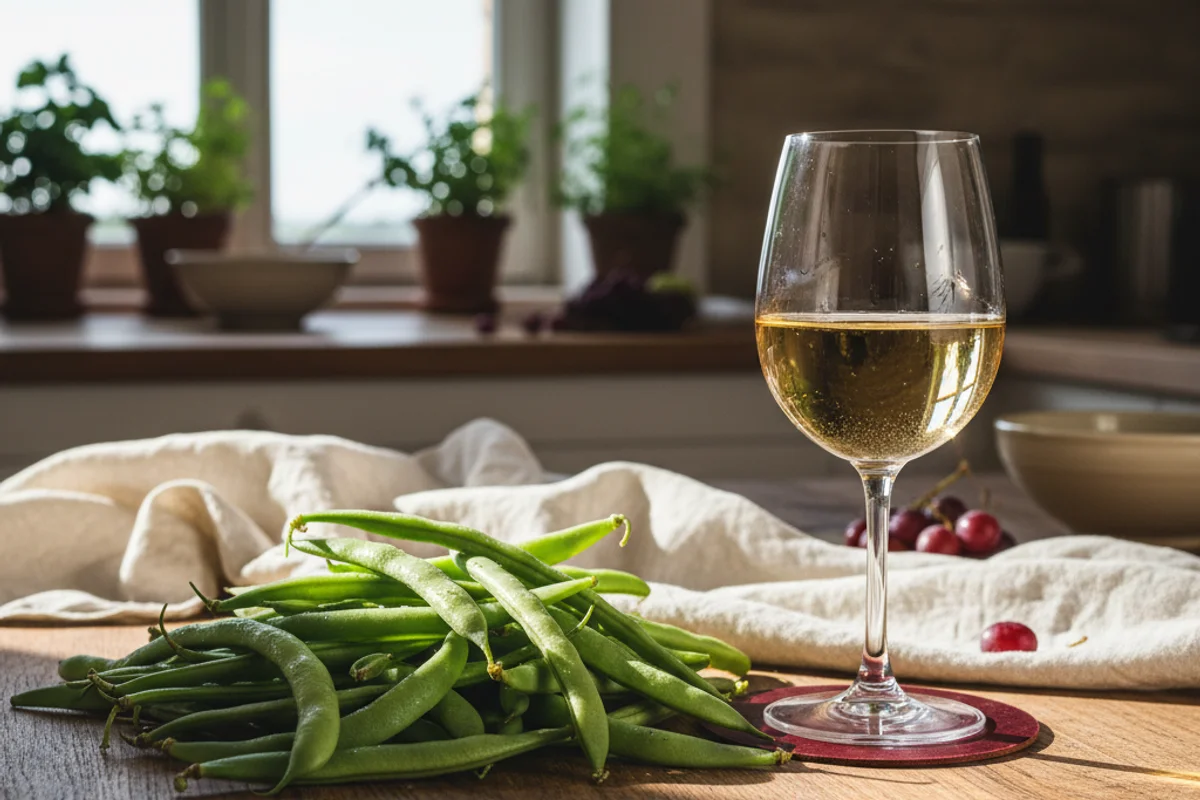
Think of green beans as a blank canvas. They bring almost no sugar, very little acid, and a mild vegetal character that practically begs to be shaped by what you add around it. The golden raisins here do the heavy lifting — body, a whisper of fruit, natural nutrients for your yeast. What you end up with is a dry, pale, lightly earthy wine that is genuinely hard to place in a blind tasting. It will not taste like Sauvignon Blanc. It will not taste like a garden salad either. It occupies its own quiet corner, and for the right drinker, that is exactly the point.
The beginner trap: Squeezing the bean bag during primary fermentation — just like you would the raisin bag — pushes bitter, starchy compounds into your must and can cause stubborn cloudiness that no amount of racking will fix.
Ingredients
- 4 lbs fresh snap beans or string beans (fresh or frozen whole beans work fine)
- 1 lb golden raisins, chopped or minced (regular raisins can substitute)
- 1⅔ lbs granulated white sugar
- 3 tsp acid blend (available at homebrew shops; substitute 2 tsp citric acid if needed)
- ¼ tsp powdered tannin (or 1 cup strong unsweetened black tea)
- 1 tsp pectic enzyme
- 1 tsp yeast nutrient
- 7 pints water, plus extra for blanching
- 1 packet Champagne or dry white wine yeast
Method
- Wash the beans and trim off any damaged ends, but do not bother removing the stems. Cut them on a diagonal into roughly 2-inch pieces to expose the inner flesh of each pod.
- Place the cut beans in a pot, cover just barely with water, and bring to a gentle simmer for 10 minutes. Drain and discard that cooking water — it holds off-flavors you do not want in your wine.
- In a separate pot, bring 7 pints of water to a boil and stir in the sugar until fully dissolved. Remove from heat and let it cool.
- Place the blanched beans in a nylon straining bag and tie it closed. Put the chopped raisins in a second, separate straining bag and tie that one closed too.
- Lower both bags into your primary fermenter and pour the cooled sugar water over them. Add the acid blend, tannin, and yeast nutrient, then stir and cover the fermenter.
- Once the must is at room temperature (below 75°F), stir in the pectic enzyme. Cover and let it rest for 12 hours.
- Activate your yeast according to the packet instructions and add it to the must. Stir daily; squeeze only the raisin bag each time — leave the bean bag alone.
- After two weeks, lift the bean bag and let it drip drain over the fermenter — save every drop. Do not squeeze it. Then gently squeeze the raisin bag, collecting that liquid too, and discard both sets of solids.
- Transfer the combined liquid to a glass carboy or secondary fermenter and seal it with an airlock.
- Rack the wine every two months for six months, topping up the vessel each time to minimize headspace and reattaching the airlock.
- If the wine does not clear on its own, treat it with an amylase (starch-clearing) enzyme, available at homebrew shops. Once it is clear and no longer dropping sediment, stabilize it.
- Sweeten to taste if desired, wait 14 days to confirm fermentation does not restart, then bottle. Age for at least one year before opening.
Why this works
Green beans contain notable amounts of starch, which is why this recipe treats them differently than most fruit wines. Starch molecules are too large for yeast to eat directly and, more importantly, they scatter light — meaning a starchy must will stay cloudy no matter how long you wait. Blanching the beans first gelatinizes some of that starch, making it easier to leave behind when you discard the cooking water. Keeping the bean bag squeezefree during fermentation prevents a second wave of starch from entering your must. If cloudiness still shows up at the end, amylase enzyme breaks those remaining starch chains into simple sugars that yeast can consume or that will simply drop out of suspension.
Notes
Frozen cut green beans work well here and save prep time — skip the blanching step if they were commercially blanched before freezing (check the bag). If you cannot find acid blend, a mix of lemon juice and citric acid from the grocery store will get you close. This wine tends toward the dry and austere side; a small back-sweetening addition at bottling time rounds it out considerably.