Strawberry Wines
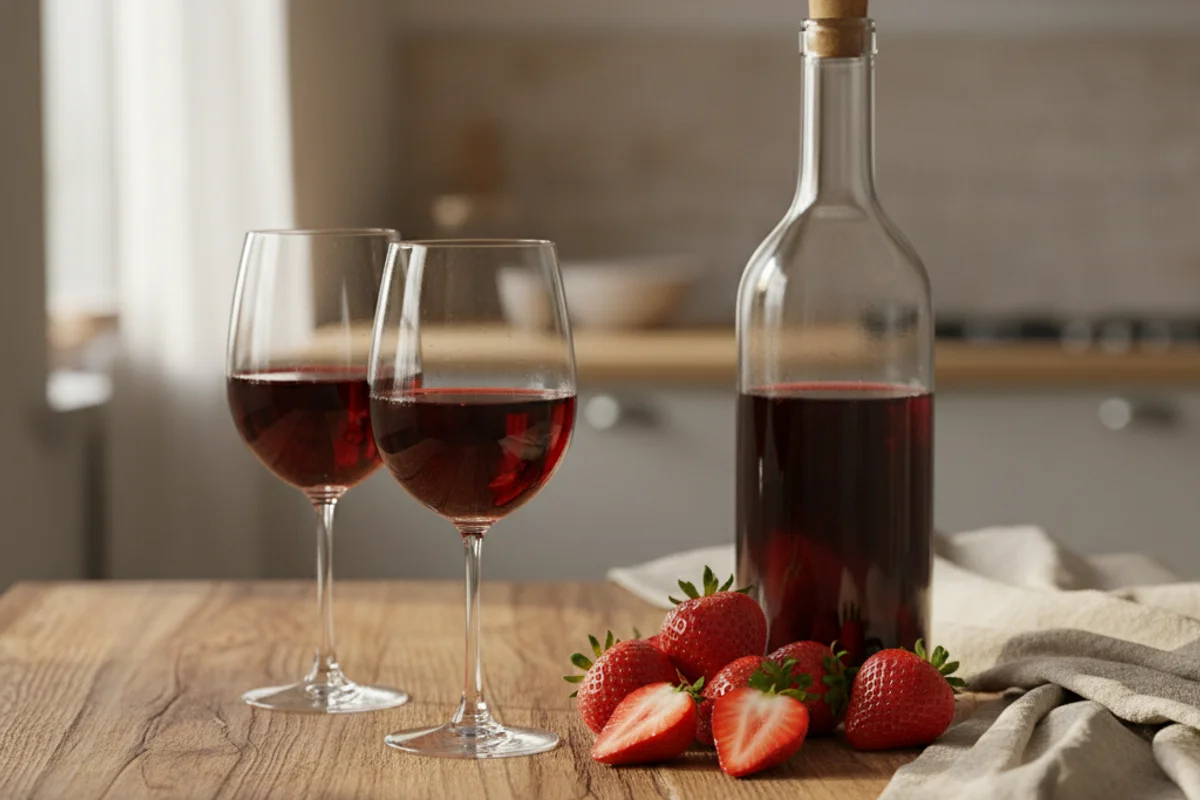
Few fruits translate to wine as directly as the strawberry. Bite into a ripe one at peak season and you already taste something close to finished: bright, floral, a whisper of acid, sweetness that doesn’t cloy. The challenge is capturing all of that in a bottle without losing the delicate aroma to heat or fermentation. Get it right and you end up with something that smells like a summer afternoon and drinks like a reward. These four recipes range from lean and simple to full-bodied and age-worthy — pick the one that matches your patience level.
The beginner trap: Strawberry aroma is fragile and volatile, so rushing fermentation at too-warm a temperature will blow off the very thing that makes this wine worth making.
Recipe 1 — Simple & Delicate
Ingredients
- 3 lbs. fresh strawberries (or frozen, thawed; see Notes)
- 2 lbs. granulated white sugar
- 2 tsp. citric acid (or 3 tbsp. fresh lemon juice as a substitute)
- Water to bring total volume to 1 gallon
- 1 packet wine yeast plus yeast nutrient (per packet directions)
Method
- Hull the strawberries and place them in a sanitized fermentation crock along with the sugar and citric acid.
- Pour 5 pints of boiling water over everything and stir vigorously until the sugar dissolves and the berries break down into a rough mash.
- Let the must cool to 85 °F, then sprinkle in the yeast and nutrient.
- Cover the crock loosely and stir it once a day for 7 days.
- On day 7, strain out the solids and transfer the liquid to a 1-gallon glass jug, topping up with cool water to reach the 1-gallon mark.
- Fit an airlock and set the jug somewhere cool and dark.
- Rack (siphon off the clear liquid, leaving the sediment behind) after 30 days, then rack again 30 days after that.
- Bottle once the wine runs clear. Age at least 6 months; 12 months is better.
Recipe 2 — More Body, Sweeter Finish
Ingredients
- 3 lbs. fresh strawberries (fresh or frozen)
- ½ lb. golden raisins, roughly chopped (adds body and natural sugar)
- 2½ lbs. light brown sugar
- 2 tsp. citric acid (or 3 tbsp. fresh lemon juice)
- ¼ tsp. grape tannin (a small bag of strong-brewed black tea works as a substitute)
- Water to bring total volume to 1 gallon
- 1 packet wine yeast plus yeast nutrient
Method
- Combine strawberries, raisins, sugar, citric acid, and tannin in a sanitized crock, then pour 5 pints of boiling water over the mixture and stir until the sugar dissolves.
- Cool to 80–85 °F, add yeast and nutrient, cover, and stir daily for 7 days.
- Strain out solids, move the liquid to a 1-gallon jug, top up to 1 gallon, and fit an airlock.
- Rack after 30 days and again after another 30 days.
- Dissolve 1 cup of granulated sugar and ⅓ tsp. citric acid in ½ cup of warm water, stir that solution into the wine, and re-fit the airlock for another 30 days.
- Rack, let it ferment 30 more days, then rack one final time.
- Bottle when clear and age at least 9 months.
Recipe 3 — Full Body, Excellent for Aging
Ingredients
- 3½ lbs. fresh strawberries, chopped (fresh or frozen)
- ¼ lb. golden raisins, chopped
- ¼ lb. pitted dates, chopped
- 2½ lbs. granulated white sugar
- 1½ tsp. acid blend (or 2 tbsp. lemon juice as a substitute)
- 2 tsp. pectic enzyme (found at homebrew shops or online)
- ¼ tsp. grape tannin (or 1 tsp. strong black tea)
- 1 Campden tablet, crushed (potassium metabisulfite; see Notes)
- 1 packet Champagne yeast plus yeast nutrient
Method
- Place the chopped fruit into a nylon straining bag, tie it closed, and set it in a sanitized crock.
- Add sugar, acid blend, and tannin to the crock, then pour 5 pints of boiling water over everything and stir until the sugar dissolves. Cover.
- After 2 hours, stir in the crushed Campden tablet. Cover again.
- After 10 more hours, stir in the pectic enzyme. Cover.
- After 12 more hours, add the yeast and nutrient. Cover and stir the bag daily for 7 days.
- On day 7, lift out the straining bag and hang it over a bowl to drip for about 2 hours — do not squeeze it.
- Pour all the collected liquid into a 1-gallon jug, top up to 1 gallon, and fit an airlock.
- Rack every 30 days. After the third racking, bottle when clear and age at least 1 year.
Recipe 4 — Light & Wild (Wild Strawberries)
Ingredients
- 3½ lbs. wild strawberries (fresh; cultivated berries work if wild aren’t available)
- 2½ lbs. granulated white sugar
- 1 tsp. acid blend (or 1½ tbsp. lemon juice)
- 1 tsp. pectic enzyme
- ¼ tsp. grape tannin (or 1 tsp. strong black tea)
- 1 Campden tablet, crushed
- Water to make 1 gallon
- 1 packet Champagne yeast plus yeast nutrient
Method
- Put the fruit in a nylon straining bag, tie it, place it in a sanitized crock, and crush the fruit through the bag with your hands.
- Add sugar, acid blend, and tannin, then pour 3 quarts of boiling water over everything and stir until the sugar dissolves. Cover.
- Once the must cools to roughly room temperature (about 2 hours), stir in the crushed Campden tablet and cover.
- After 10 more hours, add the pectic enzyme; 12 hours after that, add the yeast and nutrient.
- Cover and stir daily for 7 days, then lift and hang the straining bag over a bowl for 2 hours without squeezing.
- Transfer all liquid to a 1-gallon jug, top up to 1 gallon, and fit an airlock.
- Rack every 30 days until the wine runs clear (3–6 months), then bottle and age at least 1 year.
Why this works
Strawberries are high in water and relatively low in tannin, which is why Recipes 2–4 call for raisins, dates, or added tannin — they lend backbone the fruit alone can’t provide. Pectic enzyme (Recipes 3 and 4) breaks down pectin, a natural fiber in the fruit cell walls. Without it, pectin can form a stubborn haze in finished wine that never fully settles out no matter how long you wait. The Campden tablet does two jobs: it knocks out any wild yeast or bacteria already riding on the fruit, and it acts as a mild antioxidant to protect the wine’s color. You add it before the pectic enzyme because sulfite and enzyme work against each other — the sulfite needs a head start to do its work before the enzyme is introduced.
Notes
Frozen strawberries work well in all four recipes and often produce a cleaner must because freezing ruptures the cell walls, releasing juice more readily than crushing alone. Acid blend (a mix of citric, tartaric, and malic acids) is sold at homebrew shops; plain citric acid or fresh lemon juice is a perfectly acceptable everyday substitute. If you can’t find a Campden tablet, you can skip it in a pinch, but your risk of off-flavors from wild yeast increases — especially in Recipe 4, which uses wild berries that carry a heavier natural microbial load.