USING YOUR HYDROMETER
Think of your hydrometer as the GPS of winemaking. Without it, you’re guessing at two of the most important numbers in the whole process: how much sugar your must contains before fermentation, and how much alcohol your wine contains after. That little glass float tells you exactly where you are and where you’re headed. It costs about five dollars, takes thirty seconds to use, and eliminates the single biggest source of winemaking uncertainty for beginners and experienced hobbyists alike.
The beginner trap: Most new winemakers skip the hydrometer reading entirely and have no idea whether their wine is 8% alcohol or 14% — or whether fermentation actually finished.
Ingredients
This is a technique guide, not a recipe. No ingredients are required beyond your must or juice and the tools listed below.
- 1 hydrometer (triple-scale preferred: specific gravity, potential alcohol, and Brix/sugar)
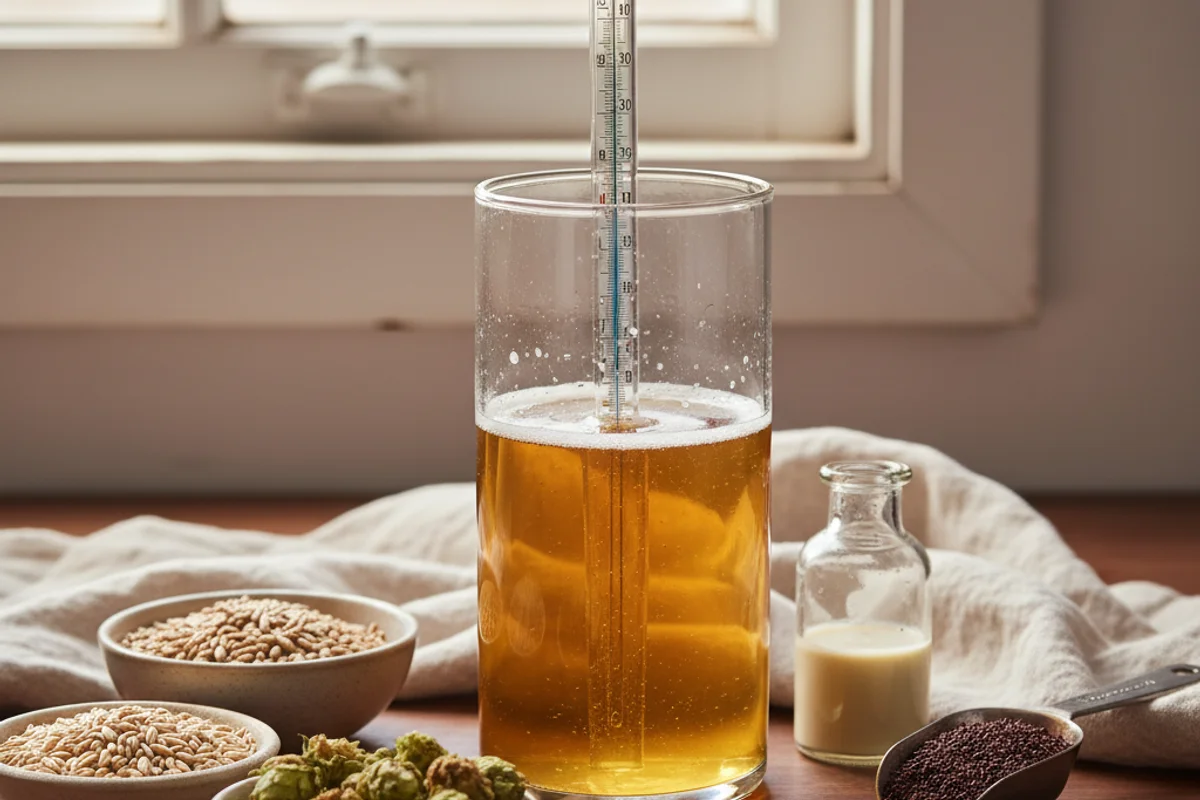
- 1 test jar (a tall, narrow plastic cylinder — about 12 inches tall — sold at homebrew shops; a clean, tall drinking glass works in a pinch)
- Juice or must from any winemaking batch
- 1 thermometer (instant-read kitchen thermometer works fine)
Method
-
Calibrate your tool first. Fill your test jar with plain tap water at 59–60°F (15°C), drop in your hydrometer, give it a gentle spin to release any bubbles, and confirm it reads 1.000. If it doesn’t, note the offset and apply it to every reading you take.
-
Take your starting reading (before yeast). Fill the test jar about two-thirds full with your must or juice, lower the hydrometer in, and let it float freely without touching the sides. Read the number at the bottom of the meniscus — the curve where the liquid meets the stem.
-
Record that number. Write it down. This is your original gravity (OG). Most table wines start between 1.085 and 1.100; a reading of 1.090 means roughly 12% potential alcohol if fermented dry.
-
Correct for temperature. Hydrometers are calibrated at 59–60°F. If your must is warmer, add a correction: +0.001 at 70°F, +0.002 at 77°F, +0.003 at 84°F, +0.005 at 95°F. Never work above 95°F — you risk killing your yeast.
-
Adjust sugar if needed. If your starting gravity is too low (below 1.085 for a table wine), dissolve plain white granulated sugar into the must. Note: 1 lb. of sugar dissolved in 1 gallon of water raises it to about 1.046. Adding sugar to an existing gallon increases the total volume slightly — account for this.
-
Take readings during fermentation. Pull a sample every two to three days. You are watching the gravity fall as yeast converts sugar to alcohol and CO₂. A reading stuck in the same place for three days in a row signals a problem worth investigating.
-
Confirm fermentation is complete. A finished dry wine typically reads between 0.990 and 1.000. Three identical readings taken 24 hours apart confirm it is done — one reading alone does not.
-
Calculate your alcohol by volume (ABV). Subtract your final gravity (FG) from your original gravity (OG) using the potential alcohol (PA) scale: read the PA at OG, read it again at FG, subtract the second from the first. Example: OG of 1.096 reads ~13% PA; FG of 0.992 means you add ~1.1% (see correction table below). Final ABV ≈ 14.1%.
-
Correction for wines that finish below 1.000. Use this table to fine-tune your ABV calculation:
| Final Specific Gravity | Add to Starting PA |
|---|---|
| 1.000 | 0.0% |
| 0.998 | 0.3% |
| 0.996 | 0.6% |
| 0.994 | 0.8% |
| 0.992 | 1.1% |
| 0.990 | 1.4% |
- Reference: Sugar, Brix, and Potential Alcohol by Specific Gravity. Use this table to dial in your starting gravity or interpret any reading:
| Specific Gravity | Sugar in 1 Gal. | Brix | Potential Alcohol |
|---|---|---|---|
| 1.000 | 0 oz. | 0.0 | 0.0% |
| 1.010 | 1.7 oz. | 3.8 | 1.4% |
| 1.020 | 5.8 oz. | 6.0 | 2.7% |
| 1.030 | 10.0 oz. | 8.2 | 4.1% |
| 1.040 | 14.0 oz. | 10.4 | 5.4% |
| 1.050 | 1 lb. 1.5 oz. | 12.6 | 6.8% |
| 1.060 | 1 lb. 5.0 oz. | 14.8 | 8.2% |
| 1.070 | 1 lb. 8.0 oz. | 17.0 | 9.5% |
| 1.080 | 1 lb. 11.5 oz. | 19.2 | 10.9% |
| 1.090 | 1 lb. 15.6 oz. | 21.4 | 12.2% |
| 1.095 | 2 lb. 1.3 oz. | 22.5 | 12.9% |
| 1.100 | 2 lb. 3.0 oz. | 23.6 | 13.6% |
| 1.110 | 2 lb. 6.3 oz. | 25.8 | 14.9% |
| 1.120 | 2 lb. 9.6 oz. | 28.0 | 16.3% |
Why this works
Yeast eats sugar and produces two things: ethanol and carbon dioxide. The more sugar you start with, the more alcohol you can potentially produce — potentially, because yeast also has an alcohol tolerance ceiling and will stop working once that ceiling is hit. A hydrometer tracks this process by measuring density. Sugar is denser than water; alcohol is less dense. As sugar disappears and alcohol builds, the liquid gets lighter and the hydrometer floats lower. The math isn’t perfect — pure alcohol has an actual specific gravity of 0.792, not 1.000 — but for practical home winemaking purposes, the potential alcohol scale gives you a working estimate accurate to within about 1%. That’s close enough to make real decisions about when to rack, stabilize, or back-sweeten your wine.
Notes
- All measurements on this page use U.S. gallons (128 fl oz). If you work in Imperial gallons, note that one Imperial gallon equals approximately 1.2 U.S. gallons — scale your sugar additions accordingly.
- “Sugar dissolved in one gallon” and “sugar added to one gallon” are not the same thing. Adding 1 lb. of sugar to an existing gallon of liquid produces about 1 gallon and 10 fluid ounces of liquid — your final volume increases slightly.
- For fruit wines (as opposed to grape wines), target a starting gravity of at least 1.090 (roughly 12% potential alcohol). Fruit wines generally need that alcohol level for safe shelf storage at room temperature.