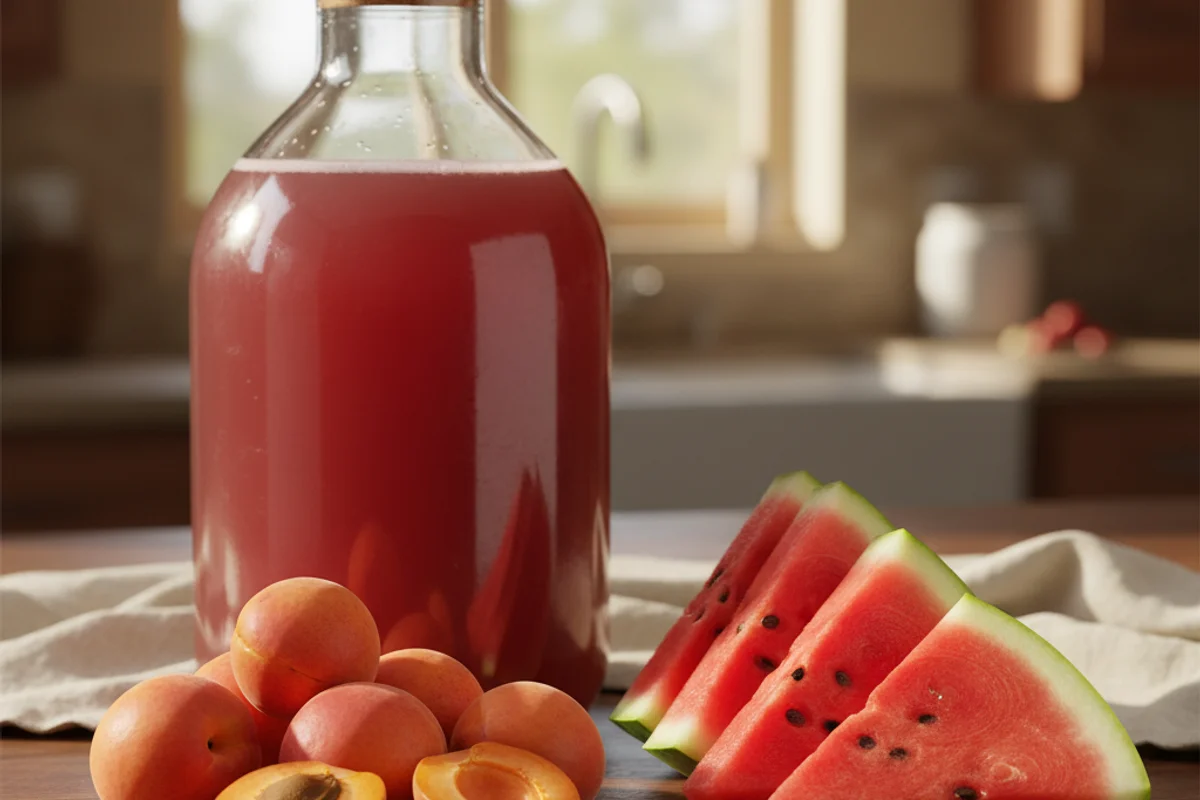
Watermelon-Apricot Wine (makes 1 gallon)
Summer in a bottle — that’s the honest pitch here. Watermelon brings a light, almost ethereal sweetness and a blush of color, while apricot adds body, a stone-fruit tang, and just enough backbone to keep things interesting. Golden raisins quietly do the background work, contributing tannin and mouthfeel without announcing themselves. The result is a wine that smells like a farmers market on a hot July morning and finishes with a gentle citrus brightness that keeps you coming back for another sip.
The beginner trap: Watermelon juice is mostly water with very little sugar or acid on its own, so skipping the acid blend and sugar measurements leaves you with a thin, flat wine that never quite comes together.
Ingredients
- 1 large watermelon (enough to yield roughly 10–12 cups of juice and pulp)
- 8 fresh apricots, pitted (or 8 oz frozen apricot halves, thawed)
- ¼ cup golden raisins, finely chopped
- Juice of 1 lemon
- Juice of 1 orange
- 4 cups granulated white sugar
- 1 tsp acid blend (find it at any homebrew shop; or substitute an extra tablespoon of lemon juice as a rough stand-in)
- 1 Campden tablet, crushed
- 1 tsp yeast nutrient
- 1 packet wine yeast (Lalvin EC-1118 or Red Star Côte des Blancs work well)
- Water to bring total must to 1 gallon
Method
- Juice the watermelon and apricots, collecting both the juice and the pulp in separate bowls. Remove all watermelon seeds and apricot pits from the pulp.
- Place the pulp in a pot with 1 quart of water. Bring to a boil and cook for 30 minutes, then strain out the solids, keeping the flavored water.
- Combine the strained pulp water with the fresh juice in a large primary fermentation vessel (a food-safe bucket works great). Let it cool until it feels just warm to the touch — like a comfortable bath.
- Add the lemon juice, orange juice, sugar, acid blend, crushed Campden tablet, yeast nutrient, and chopped raisins. Top up with plain water until the total volume reaches 1 gallon and stir well to dissolve the sugar.
- Cover the vessel with a clean cloth and leave it alone for 24 hours. This gives the Campden tablet time to knock out any wild microbes before your yeast takes over.
- Sprinkle in the wine yeast, re-cover with the cloth, and stir the must once a day for 7 days.
- After 7 days, strain out and discard the raisins. Let the must settle for another 24 hours, then rack (siphon) it off the sediment.
- Transfer the wine into a 1-gallon glass jug (secondary fermentation vessel), fit an airlock, and leave it undisturbed for 4 weeks.
- Rack again to clear out settled lees, wait another 4 weeks, then rack one final time once the wine looks clear and bright.
- Bottle the finished wine. Wait at least 6 months before opening the first bottle — longer if you can stand it.
Why this works
Watermelon is roughly 92% water, which means its sugar and acid levels are naturally low. Boiling the pulp does two things at once: it extracts color pigments and flavor compounds that pure juicing leaves behind, and it pasteurizes the pulp so you’re not fighting a wild yeast population later. The Campden tablet (sodium metabisulfite) handles anything the boil misses in the cold juice. Golden raisins contribute oligomeric proanthocyanidins — basically plant tannins — which give the wine structure and help it age gracefully. Apricots bring tartaric and malic acids along with beta-carotene, which is part of why the finished wine holds such a warm, golden-apricot hue.
Notes
Frozen apricots work just as well as fresh and are often more reliably ripe; thaw them completely and use all the collected juice. If you can’t find acid blend at a local homebrew shop, it’s widely available online — but in a pinch, an extra tablespoon of lemon juice per gallon is a reasonable substitute. If your wine is still hazy after the final 4-week rest, a teaspoon of store-bought pectic enzyme (added at the start of fermentation next time) will prevent that cloudiness entirely, since both watermelon and apricot are high in pectin.