Watermelon-Grape Wine (makes 1 gallon)
Summer in a bottle — that’s the honest pitch here. Watermelon brings a delicate, almost shy sweetness and a flood of juice, while table grapes add the body and tannin that watermelon simply cannot supply on its own. Fresh lemon zest ties the two together with a citrus brightness that keeps the finished wine from tasting flat or one-dimensional. The result is a pale, blush-toned wine that drinks like a warm afternoon: easy, fragrant, and just interesting enough to make you pour a second glass before you’ve finished thinking about the first.
The beginner trap: Watermelon juice is almost entirely water and sugar with very little structure, so skipping the grapes — or skimping on them — leaves you with a thin, watery wine that no amount of back-sweetening will fix.
Ingredients
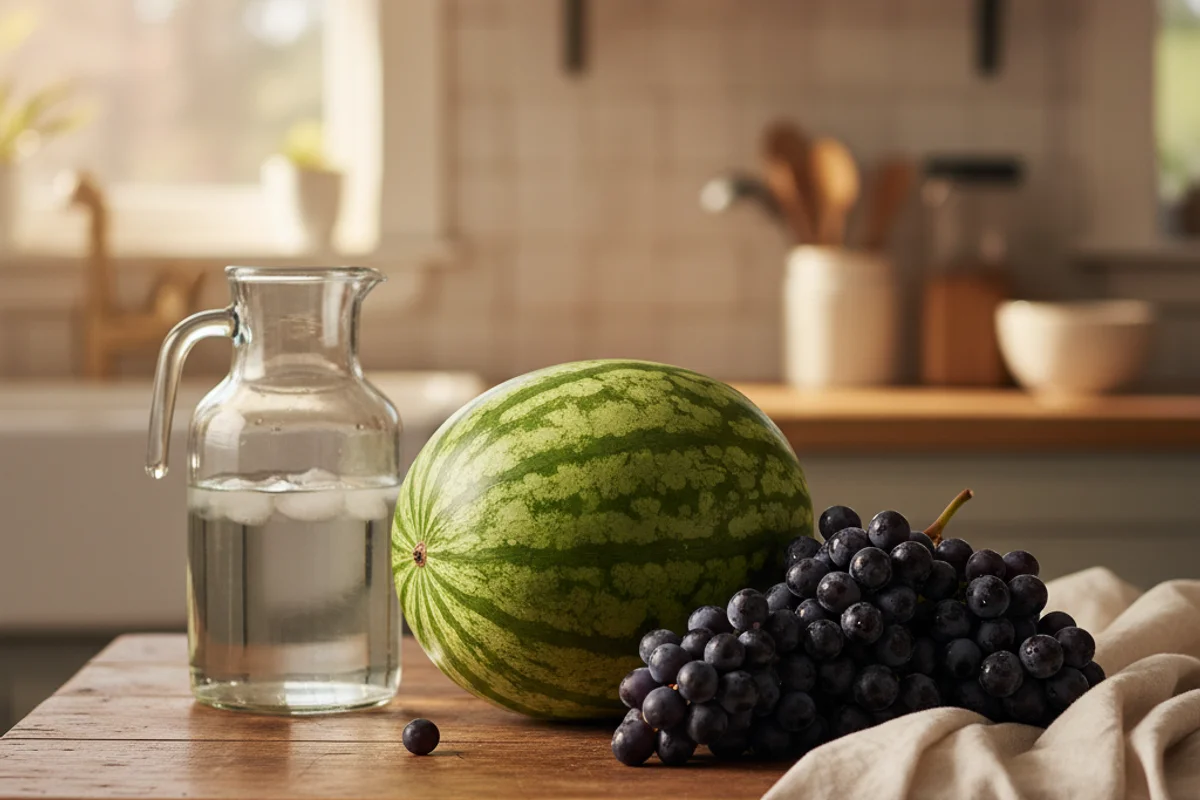
- 8–10 lb watermelon (flesh only, rind removed)
- 3½ lb fresh red or green table grapes (seedless grocery-store grapes work great)
- 3½ cups granulated white sugar
- Juice and zest of 2 lemons
- 1 tsp pectic enzyme
- 1 tsp yeast nutrient
- 2 Campden tablets, crushed and divided (or ¼ tsp potassium metabisulfite per tablet)
- ¼ tsp potassium sorbate (for stabilizing before bottling)
- 1 packet wine yeast (Lalvin EC-1118 or Red Star Côte des Blancs are solid choices)
- Water to reach 3¾ quarts total volume
Method
- Cut the watermelon flesh into rough 1-inch cubes, discard loose seeds, and place the fruit and all free-running juice into your primary fermenter.
- Zest both lemons using only the bright yellow outer layer, then juice them; add both the zest and juice to the fermenter.
- Wash, destem, and crush the grapes thoroughly in a large bowl, then add the crushed grapes, all their juice, and 1 crushed Campden tablet to the fermenter.
- Add water as needed to bring the total volume to 3¾ quarts, then pour in the sugar and stir until fully dissolved.
- Cover the fermenter with a clean cloth and wait 12 hours, then stir in the pectic enzyme and yeast nutrient.
- Wait another 12 hours, then sprinkle in the wine yeast; cover and ferment for 5–7 days, stirring the must once daily.
- Strain the liquid into a 1-gallon glass carboy through a nylon straining bag, squeezing the pulp firmly to extract every drop of juice.
- Fit an airlock and let the wine ferment undisturbed for 30 days.
- Rack the wine off its sediment into a clean carboy, top up to the shoulder with water or a splash of similar wine, refit the airlock, and wait another 30 days.
- Rack again, top up, and wait 60 more days.
- Rack one final time, then stabilize: stir in ¼ tsp potassium sorbate and 1 crushed Campden tablet; top up and refit the airlock.
- After 10 days, rack, sweeten to taste if desired, and bottle; age at least 1 year before drinking.
Why this works
Watermelon is about 92% water, which means it brings almost no tannin, very little acid, and a fragile flavor that fades fast under fermentation stress. Grapes solve two of those three problems at once — their skins carry tannin for structure and preservative power, and their pulp adds natural acids that keep the pH in a range where yeast thrive and spoilage microbes struggle. The two-stage Campden addition — one hit at the start to knock out wild yeast and bacteria, one at stabilization to prevent re-fermentation in the bottle — keeps the wine clean without over-sulfiting it. Pectic enzyme breaks down the pectin gel inside both fruits, which produces clearer juice and a brighter finished wine.
Notes
If fresh table grapes aren’t available, 3½ lb of frozen seedless grapes (thawed) work just as well — the freeze-thaw cycle actually breaks down the cell walls and makes crushing easier. Lemon zest can be swapped for ½ tsp of dried lemon peel (found in the spice aisle) if fresh lemons aren’t on hand, though fresh is noticeably better. If the wine tastes sharp after aging, a small addition of sugar syrup at bottling time rounds it out nicely.