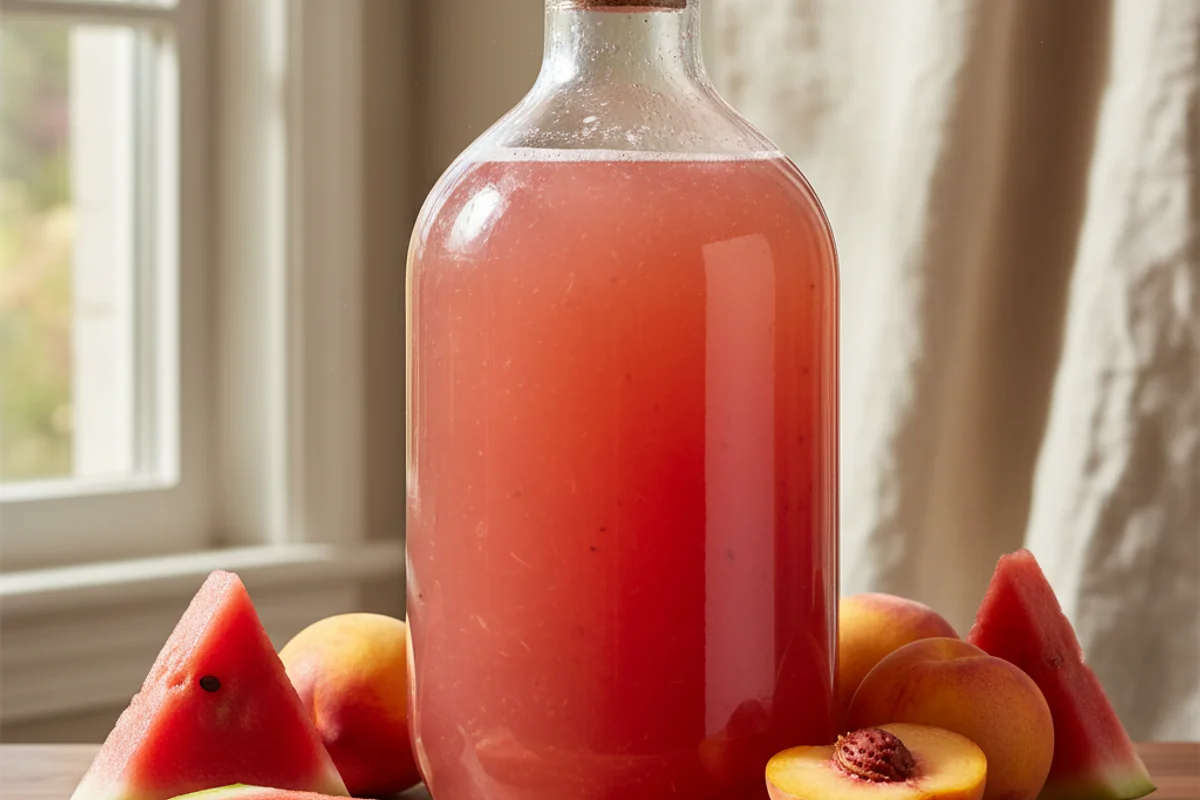
Watermelon-Peach Wine (makes 1 gallon)
Watermelon is mostly water — about 92% of it, to be exact — which makes it a surprisingly generous juice source but a tricky winemaking partner. On its own, it produces a thin, fleeting wine that fades fast. Peaches bring body, stone-fruit depth, and a floral note that fills in the gaps. Lime juice adds a citrus backbone that keeps the whole thing from going flat and sweet. The result is a summer-in-a-bottle wine: bright, a little tropical, and genuinely refreshing served cold.
The beginner trap: Skipping the pulp-boiling step to save time will cost you color, flavor, and body — that simmering water pulls out everything the squeezer left behind.
Ingredients
- 1 large watermelon (enough to yield roughly 3 quarts of juice and pulp combined)
- 2 medium peaches, fresh or frozen, pitted and chopped
- ¼ cup raisins, chopped (acts as a natural yeast nutrient and body builder)
- Juice of 3 limes (about 6 tablespoons)
- 5 cups granulated white sugar
- 1 quart water
- 1 tsp acid blend (find it at homebrew shops, or substitute an extra tablespoon of lime juice)
- 1 Campden tablet, crushed (a.k.a. potassium metabisulfite — sold at homebrew stores)
- 1 tsp yeast nutrient (sold at homebrew stores; optional but recommended)
- 1 packet wine yeast (Lalvin 71B or EC-1118 both work well)
Method
- Juice the watermelon and peaches, collecting all the juice in your primary fermenter. Save all the pulp — do not throw it away.
- Place the pulp in a pot with 1 quart of water and bring to a boil. Simmer for 30 minutes, then strain out and discard the solids.
- Add the strained pulp-water to the juice in your primary fermenter, topping up with plain water if needed to reach 1 gallon total.
- Let the mixture cool to lukewarm (around 70–75°F / 21–24°C).
- Stir in the raisins, lime juice, sugar, acid blend, yeast nutrient, and crushed Campden tablet. Stir well until the sugar fully dissolves.
- Cover the fermenter with a clean cloth and leave it alone for 24 hours to let the Campden tablet do its sanitizing work.
- After 24 hours, sprinkle in the wine yeast. Cover again and stir the must once per day for 7 days.
- On day 7, strain out and discard the raisins. Let the must settle for another 24 hours, then rack (siphon) the liquid into a 1-gallon glass jug or carboy, leaving sediment behind.
- Fit the jug with an airlock and set it somewhere cool and dark for 4 weeks.
- Rack again into a clean jug, refit the airlock, and wait another 4 weeks.
- Rack one final time once the wine has cleared. Bottle it and wait at least 2–4 months before opening.
Why this works
Watermelon juice is low in tannins, low in acid, and very low in the nutrients yeast need to thrive. The raisins solve the nutrient problem — they’re loaded with nitrogen compounds and natural sugars that keep fermentation healthy and reduce the risk of off-flavors like hydrogen sulfide. Boiling the pulp breaks down cell walls through a process called thermal extraction, releasing pigments, sugars, and flavor compounds that cold pressing misses entirely. The Campden tablet knocks out wild yeast and bacteria on day one, giving your chosen wine yeast a clean runway. Lime juice and acid blend lower the pH into the range (roughly 3.2–3.5) where wine yeast are happy and spoilage organisms are not.
Notes
Frozen peaches work just as well as fresh and are often more consistent — thaw them completely before juicing. If you can’t find acid blend, extra lime juice is a workable stand-in, though the flavor profile will shift slightly citrus-forward. If fermentation seems sluggish after 48 hours, stir gently and make sure your room temperature is above 65°F.