WELCH’S GRAPE JUICE WINE
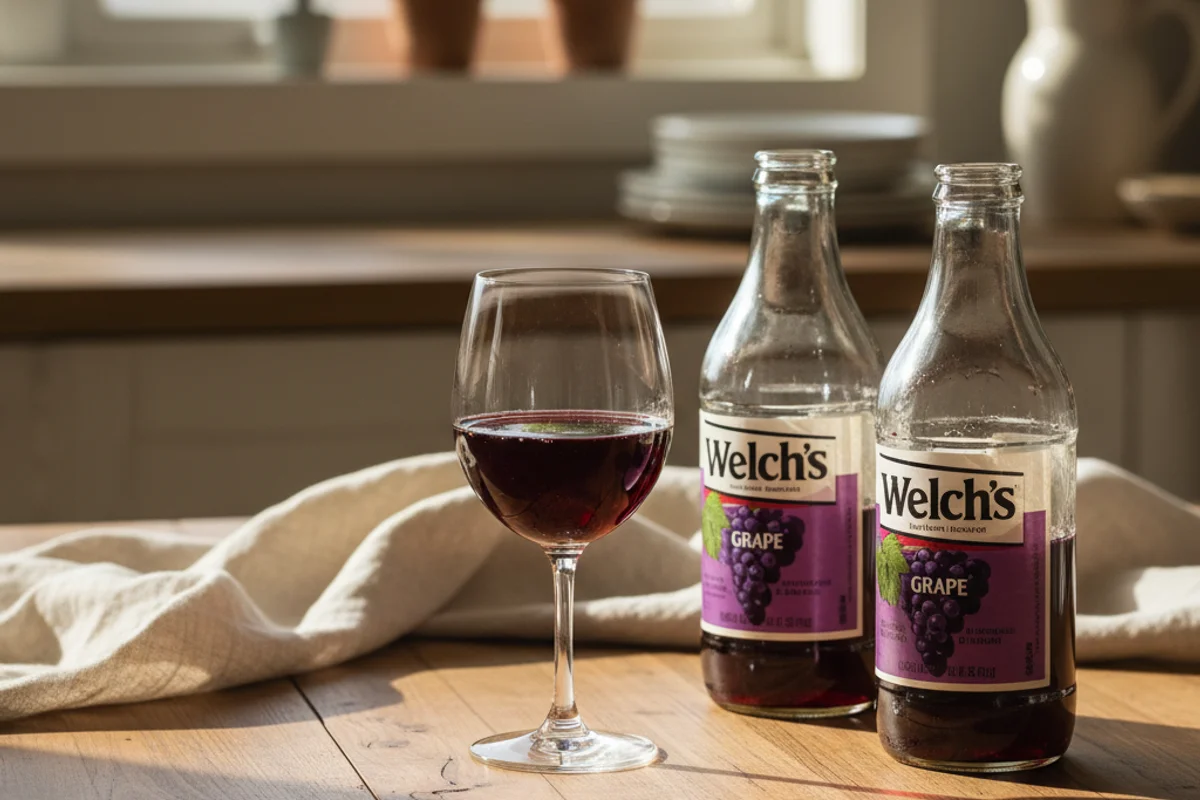
Concord grapes smell like grape candy and taste like Sunday morning. Welch’s figured that out a long time ago, and it turns out that same bold, foxy flavor that makes their juice iconic also makes a surprisingly drinkable country wine. You’re not chasing a Bordeaux here — you’re making something honest, affordable, and deeply familiar. The red (Concord) runs jammy and full, while the white (Niagara) stays light and floral. Either way, your starting point is the grocery store freezer aisle, and your finish line is a glass of something you actually made yourself.
The beginner trap: Bottled Welch’s juice contains sulfites to keep it shelf-stable, and dumping yeast straight into it almost guarantees a stuck or failed fermentation — build a yeast starter first.
Ingredients
- 1 gallon Welch’s 100% Grape Juice Frozen Concentrate (red or white), thawed — or bottled Welch’s if that’s what you have
- ¾–1 cup granulated white sugar (enough to raise specific gravity to 1.095)
- 2 tsp acid blend (find it at homebrew shops; lemon juice is a weak substitute but not ideal)
- 1 tsp pectic enzyme
- 1 tsp yeast nutrient
- 1 packet Montrachet wine yeast (Red Star or Lalvin 71B work fine too)
Method
- Two to three days before you plan to start, build a yeast starter: combine ½ cup of grape juice, ½ cup of warm water, ¼ tsp sugar, and a small pinch of yeast nutrient in a clean quart jar, then sprinkle in the yeast, cover loosely, and let it sit at room temperature until it’s actively bubbling.
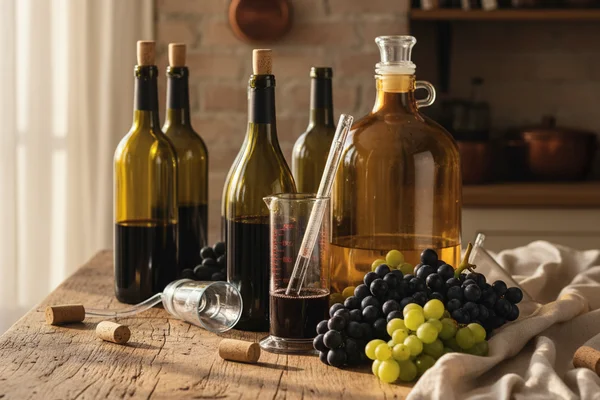
- Pour the grape juice into your primary fermenter (a food-grade bucket works great) and float your hydrometer in it to read the starting sugar level.
- Stir in enough sugar to push the specific gravity up to 1.095, mixing well — vigorous stirring also helps drive off any dissolved sulfites in bottled juice.
- Add the acid blend, pectic enzyme, and yeast nutrient; stir to combine, then cover the fermenter and leave it alone for 12 hours.
- Every 2 hours during those 12 hours, add a splash (about ¼ cup) of grape juice to your yeast starter jar to build up a strong, healthy colony.
- After 12 hours, pour the active yeast starter into the fermenter and re-cover it.
- Ferment at room temperature for 5–7 days, stirring once daily, until the vigorous bubbling slows down noticeably.
- Transfer (rack) the wine into a clean 1-gallon glass jug, leaving sediment behind, and fit an airlock.
- Once the wine clears — usually 3–4 weeks — rack it again into a clean jug, top it up to reduce headspace, and refit the airlock.
- After another 30 days, stabilize with potassium sorbate and potassium metabisulfite (follow package rates), sweeten to taste if you’d like, and wait 10–14 days to confirm fermentation doesn’t restart.
- Rack carefully into bottles and age at least 3 months before opening — 6 months is better.
Why this works
Sulfur dioxide is the preservative Welch’s uses to keep bottled juice from fermenting on the shelf — which is exactly what you’re trying to make it do. The two-step fix here is mechanical and biological. Vigorous stirring lets SO₂ escape as a gas (it’s volatile). Meanwhile, building up a large, active yeast colony in a low-sulfite starter gives your yeast a numbers advantage — when you finally pitch them, there are enough cells to push through any remaining sulfite resistance and establish a healthy fermentation before anything goes wrong. Frozen concentrate skips the whole problem because it’s pasteurized rather than sulfited, which is why it’s the easier path.
Notes
Frozen concentrate is strongly recommended over bottled juice — it’s cheaper per gallon, sulfite-free, and ferments reliably without the starter workaround (though building a starter is still good practice). If you can’t find acid blend at a local homebrew shop, order it online; it’s inexpensive and worth having on hand. For a sweeter finished wine, add sugar in small increments after stabilizing and taste as you go.