WELCH’S WHITE GRAPE AND PEACH WINE
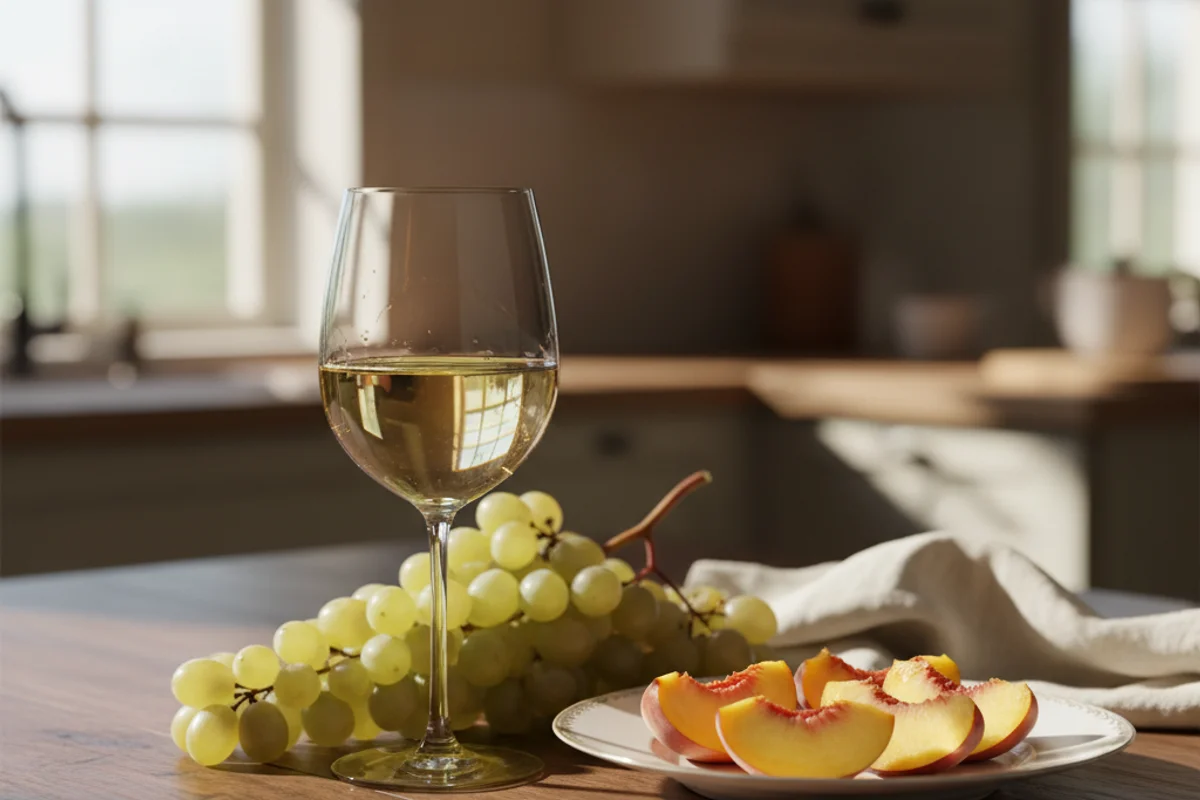
Think of this as a shortcut to something genuinely drinkable. Two cans of frozen concentrate from the grocery store juice aisle, a handful of additives, and about two months of patience will get you a light, fruity wine with real white-grape character and a soft peach finish. It lands somewhere between a dry Riesling and a fruit punch — bright, slightly floral, and refreshing cold. This is the kind of wine you open on a warm afternoon without overthinking it.
The beginner trap: Skipping pectic enzyme — without it, peach-based wines stay stubbornly cloudy no matter how long you wait.
Ingredients
- 2 cans (11.5 oz each) Welch’s White Grape and Peach frozen concentrate
- 1¼ lbs granulated sugar
- 2 tsp acid blend (find it at any homebrew shop, or online)
- 1 tsp pectic enzyme
- 1 tsp yeast nutrient
- Water to make 1 gallon total
- 1 packet Sauterne wine yeast (or any white wine yeast such as Lalvin 71B)
Method
- Bring 1 quart of water to a boil and dissolve the sugar in it completely. Remove from heat.
- Stir in the frozen concentrate until fully thawed and combined.
- Pour the mixture into your primary fermenter and add enough cool water to reach 1 gallon total.
- Add the acid blend, pectic enzyme, and yeast nutrient. Stir well, cover the fermenter loosely, and let it sit for 12 hours.
- Activate your yeast according to the packet instructions, then add it to the must and recover the fermenter.
- Ferment at room temperature, stirring daily. When visible bubbling slows significantly — usually 5 to 7 days — transfer to a 1-gallon glass jug and fit an airlock.
- Once the wine runs clear, rack it off the sediment into a clean jug, top up with a little water or similar wine to minimize headspace, and refit the airlock.
- Wait 30 days and rack again, topping up as before.
- After another 30 days, stabilize with potassium sorbate and potassium metabisulfite, sweeten to taste if desired (a finished gravity around 1.006 gives a pleasant off-dry result), then bottle.
Why this works
Peaches are loaded with pectin — the same stuff that makes jam gel. In a wine must, pectin molecules tangle together and trap fine particles, creating a persistent haze that won’t drop out on its own. Pectic enzyme is a protein that breaks those pectin chains apart, freeing the particles to clump and fall to the bottom. Adding it 12 hours before the yeast goes in gives it time to work before alcohol levels rise, since higher alcohol slows the enzyme down. The acid blend fine-tunes the pH into the range where yeast performs well and where the wine tastes balanced — not flat, not sharp.
Notes
If you can’t find Sauterne yeast locally, Lalvin 71B or EC-1118 both work well and are widely available online or at homebrew stores. Want a stronger wine? Add a third can of concentrate and use your hydrometer to check the starting gravity before adding any extra sugar — you may need little to none. If you want a sweeter finish without back-sweetening, stop fermentation early by cold crashing and stabilizing once you hit your target gravity.