WHITECURRANT WINES
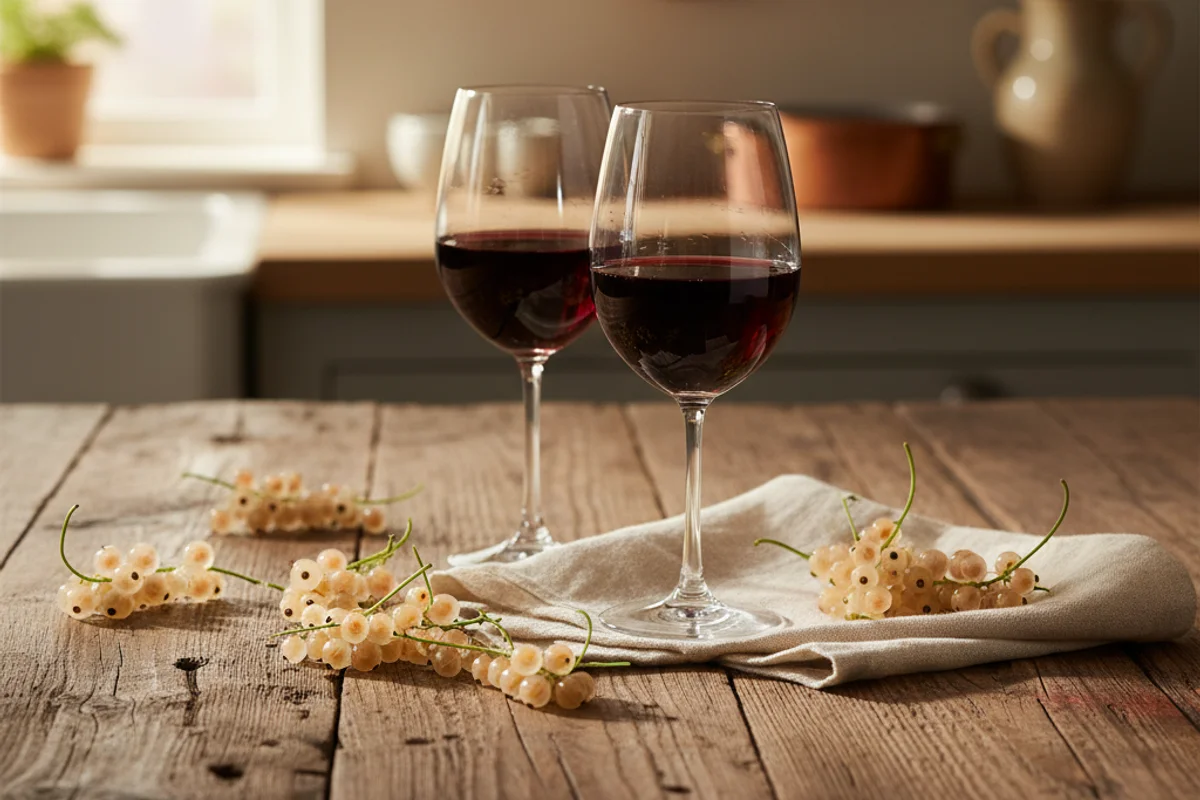
White currants are the quiet overachievers of the Ribes family. They look almost luminous — pale, translucent berries that taste like red currants dialed back to something gentler: floral, lightly tart, with a honey-like sweetness underneath. That restrained flavor profile is exactly what makes them interesting in wine. You’re not fighting the fruit; you’re coaxing it. The result, given enough patience, is a delicate, pale wine that earns its place at the table. Three recipes are included here, scaling from light to fuller-bodied depending on how much fruit you have on hand.
The beginner trap: Rushing the racking schedule — white currant wine needs multiple racking cycles and at least six months of bottle aging to shed its rough edges and let the delicate fruit come forward.
Recipe 1 — Light Style
Ingredients
- 2½ lbs ripe white currants, fresh or frozen
- 2 lbs granulated sugar
- 7 pts (3.5 quarts) water, divided
- 1 Campden tablet, crushed
- 1 tsp yeast nutrient
- 1 pkg Tokay wine yeast (or any white wine yeast, such as Lalvin 71B)
Method
- Place the fruit in your primary fermenter and crush it thoroughly with clean hands or a potato masher.
- Add 1 quart of water, the crushed Campden tablet, and the yeast nutrient; stir well to combine.
- Dissolve half the sugar in a separate quart of boiling water, stirring until fully clear, then add it to the primary and stir again.
- Cover the fermenter loosely and let it cool overnight to below 75°F (24°C).
- Activate your yeast according to the packet instructions, then add it to the cooled must; re-cover and stir daily for 5–6 days.
- Strain the pulp through a fine mesh strainer or nylon straining bag into a sanitized secondary fermenter (carboy), then fit an airlock.
- Dissolve the remaining sugar in a third quart of boiling water; let it cool completely, then add it to the secondary and refit the airlock.
- After 3 more days, top up the carboy with water to reduce headspace, refit the airlock, and leave it undisturbed until bubbling stops.
- Rack the wine into a clean carboy, top up, and refit the airlock; repeat this step at 60 days and again at 120 days.
- After the final 60-day rack, bottle the wine and age at least 6 months before opening.
Recipe 2 — Clear-Pull Style
Ingredients
- 3 lbs white currants, fresh or frozen
- 2 lbs granulated sugar
- 7 pts (3.5 quarts) water, divided
- 1 Campden tablet, crushed
- 1 tsp yeast nutrient
- 1 pkg Burgundy wine yeast (or Lalvin RC-212)
Method
- Crush the fruit in your primary fermenter, add 1 quart of water and the crushed Campden tablet, stir, then cover and leave for 12 hours.
- Strain the pulp through a nylon straining bag, squeezing the bag firmly to extract as much juice as possible.
- Pour the strained juice into a jelly bag suspended over a large bowl and let it drip-drain completely — do not squeeze the bag; just wait.
- Once all the juice has dripped through, pour it into a stainless steel saucepan, bring it to a boil, reduce to a simmer, and hold for 5 minutes, skimming any foam that rises.
- Separately, dissolve half the sugar in a quart of boiling water, then combine the sugar-water and the simmered juice together in a clean primary fermenter.
- Stir in the yeast nutrient, cover, and let the mixture cool to below 75°F (24°C).
- Add activated yeast, re-cover, and stir daily for 10 days.
- Dissolve the remaining sugar in another quart of boiling water, let it cool completely, then add it to the primary; cover and leave for another 3–4 days.
- Transfer to a sanitized secondary carboy, top up with water, and fit an airlock.
- Rack every 30 days, topping up each time, until the wine runs clear and produces no further sediment.
- Stabilize with a crushed Campden tablet and ½ tsp potassium sorbate, bulk age 3 months under airlock, then bottle and age 6 months before tasting.
Recipe 3 — Full-Bodied Style
Ingredients
- 4–5 lbs ripe white currants, fresh or frozen
- 2 lbs granulated sugar
- 6½ pts (about 3¼ quarts) water, divided
- 1 Campden tablet, crushed
- 1 tsp yeast nutrient
- 1 pkg Burgundy wine yeast (or Lalvin RC-212)
Method
- Follow the same steps as Recipe 1 exactly, using the adjusted water volume and the higher fruit quantity.
- The extra fruit deepens the body and flavor; expect a longer clearing time — don’t skip the 60-day racking intervals.
Why this works
White currants are naturally low in tannin and produce a relatively thin must. Splitting the sugar addition across two doses — some before fermentation, some after — keeps the yeast from getting overwhelmed by osmotic stress early on. A stressed yeast makes fusel alcohols, which smell like nail polish remover and take years to mellow out. The jelly-bag step in Recipe 2 removes excess pectin before it gets heat-set into a permanent haze. Boiling the juice afterward kills wild yeast and bacteria while also helping any remaining pectin proteins coagulate and drop out. That’s why the warning matters: squeeze the jelly bag and you force fine pulp particles through that no amount of fining or time will clear.
Notes
Frozen white currants work well in all three recipes — freezing actually helps break down cell walls and improves juice yield; no extra prep needed beyond thawing. If you can’t find Tokay yeast (also sold as Pasteur Gold), any neutral white wine yeast such as Lalvin 71B or EC-1118 works fine. If white currants are unavailable locally, check Eastern European grocery stores or online fruit suppliers — they’re more common than most produce aisles suggest.