Yellow Raspberry Wine
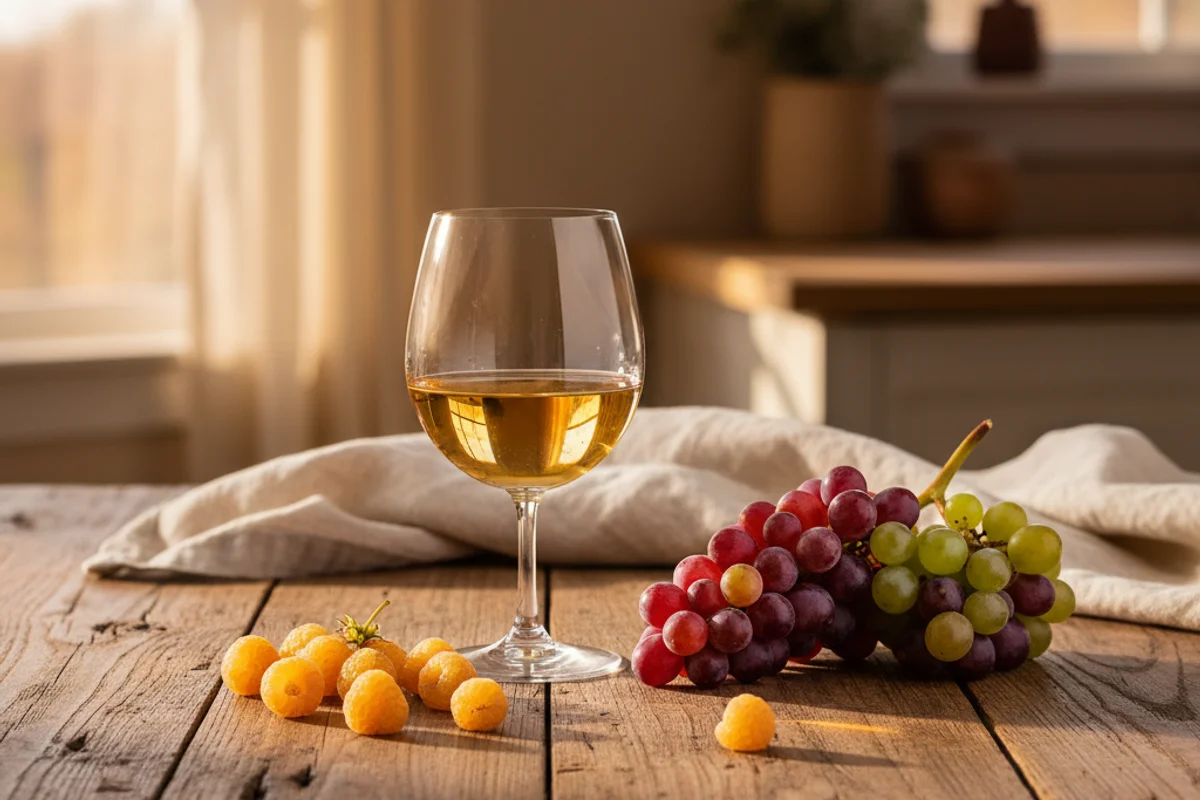
Yellow raspberries are the quiet overachievers of the cane fruit world. Where red raspberries lead with tartness, these golden varieties — Fall Gold, Anne, Kiwi Gold — lean sweet and almost floral, with a honeyed depth that translates beautifully into wine. The finished glass is pale straw to soft gold, smells like a summer garden, and drinks with a delicacy you won’t get from their red cousins. This is a one-gallon recipe built around fruit-forward character and a clean, fruit-preserving yeast that keeps every bit of that aroma in the bottle.
The beginner trap: Skipping the pectic enzyme means you’ll end up with a cloudy, hazy wine that refuses to clear no matter how long you wait — pectin from the fruit locks in that haze permanently.
Ingredients
- 4½ to 5 lbs. yellow or gold raspberries, fresh or frozen
- ¾ to 1¼ lbs. granulated white sugar (start lower for sweeter fruit)
- ¼ tsp. malic acid (or a small squeeze of fresh lemon juice as a substitute)
- ½ tsp. pectic enzyme
- 1 tsp. yeast nutrient
- 1 packet Lalvin 71B yeast (widely available at homebrew shops or online)
- Water to bring total volume to 1 gallon
Method
- If using frozen berries, thaw them completely and discard any that look soft, moldy, or unripe.
- Dissolve the sugar in a portion of warm water, then let it cool to room temperature before adding it to your primary fermenter.
- Place the berries in a nylon straining bag, tie it closed, and gently crush the fruit inside the bag directly in the primary fermenter.
- Add the sugar water, malic acid, pectic enzyme, and yeast nutrient to the primary; stir to combine. Do not add yeast yet.
- Cover the fermenter loosely and let it sit for 10 to 12 hours — this gives the pectic enzyme time to break down the fruit before fermentation begins.
- Activate your yeast according to packet instructions, then pitch it into the must and stir gently.
- Ferment for 7 to 8 days, or until the specific gravity drops to around 1.030, stirring the bag daily and keeping the fermenter covered.
- Lift out the straining bag and squeeze it gently to recover juice; do not wring hard or the wine can turn bitter.
- Let the liquid settle overnight in the covered primary, then rack it into a 1-gallon glass jug (secondary fermenter) and attach an airlock.
- Rack again after 30 days, topping up with a little water or similar wine to minimize headspace, then again at 60 days.
- After that, rack every 60 days until the wine is fully clear and produces zero new sediment over a full 60-day window — not even a thin dust layer.
- Stabilize with potassium sorbate and potassium metabisulfite, sweeten to taste if desired, then wait 3 to 4 weeks to confirm fermentation does not restart.
- Bottle the wine and age for at least one year before drinking.
Why this works
Lalvin 71B is chosen here for a specific reason: it partially metabolizes malic acid through a process called partial malolactic conversion, softening any harsh edges in the wine and keeping the fruit aromas intact. Most yeasts would just chew through the sugar and leave; 71B lingers and actively shapes the flavor. The small addition of malic acid (rather than the more common tartaric or citric acid) echoes the natural acid profile of raspberries and keeps the wine tasting true to the fruit. Pectic enzyme does the structural groundwork — it breaks down the pectin chains in the cell walls of the berries, releasing more juice, more color, and more flavor while preventing the permanent pectin haze that ruins clarity in fruit wines.
Notes
Frozen yellow raspberries work just as well as fresh ones here — the freezing actually ruptures cell walls and improves juice extraction, so don’t hesitate to use them. If you can’t find malic acid at a homebrew shop, a teaspoon of fresh lemon juice is a reasonable stand-in for this small quantity. If the finished wine tastes too thin, the next batch calls for the full 5 lbs. of fruit; if it tastes jammy or heavy, pull back toward the 4½ lb. end.