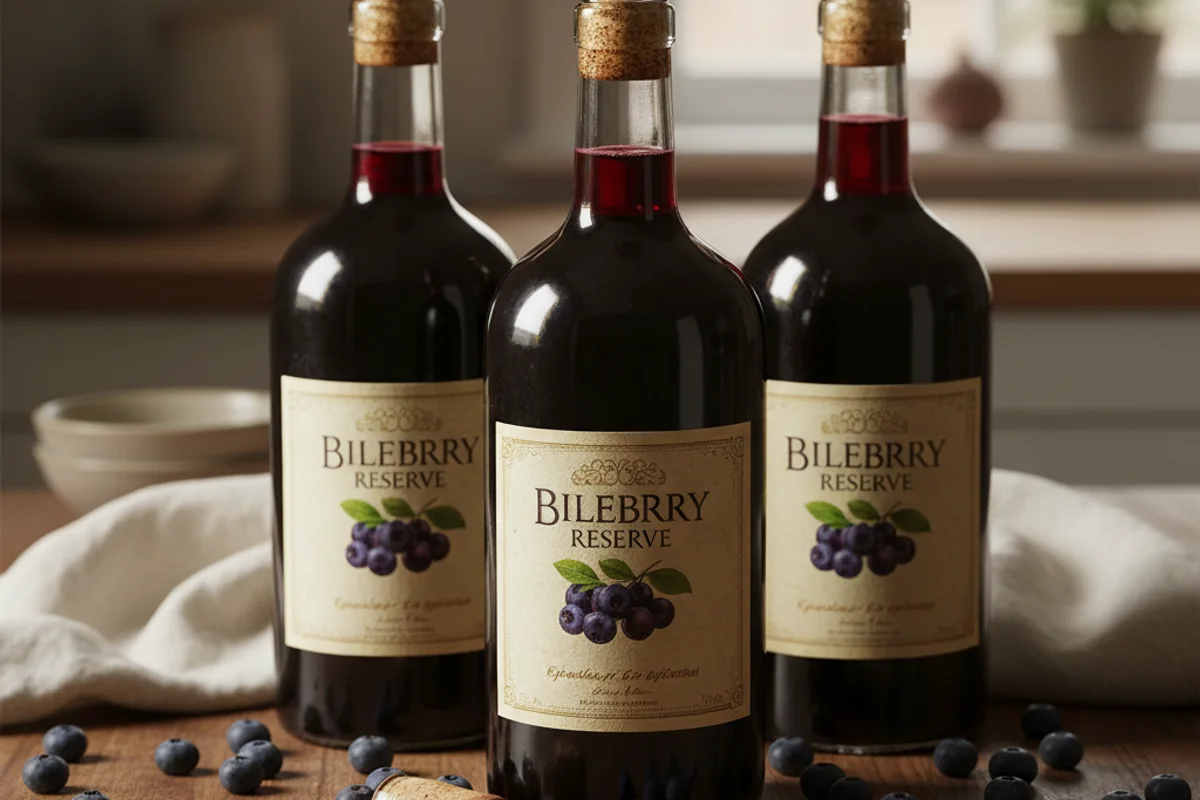
BILBERRY WINE (3)
Bilberries are the wild, ink-dark cousins of the blueberry — smaller, more intensely flavored, and packed with anthocyanins that stain everything they touch a deep, bruised purple. Dried bilberries punch well above their weight here, delivering a concentrated, almost jammy fruit character that red grape concentrate rounds out into something genuinely wine-like. A whisper of dried elderflower lifts the whole thing, adding a floral top note that keeps it from feeling heavy. The result is a deep, full-bodied country wine that earns its 9–12 months of patience.
The beginner trap: Skipping or shortcutting the pectic enzyme rest will leave your finished wine permanently cloudy — dried fruit is loaded with pectin, and no amount of fining will fully fix it later.
Ingredients
- 5–8 oz dried bilberries (see Notes)
- 1/8 oz dried elderflowers (or 1/4 tsp elderflower cordial as a rough stand-in)
- 6–8 oz red grape concentrate (Welch’s 100% grape juice concentrate works in a pinch)
- 2 lbs granulated white sugar
- 2/3 tsp acid blend (or 1 tsp lemon juice per gallon as a backup)
- 1 tsp pectic enzyme
- 1 tsp yeast nutrient
- Water to make 1 gallon
- 1 packet Bordeaux wine yeast (or any dry red wine yeast)
Method
- Bring most of your water to a boil, then pour it over the dried bilberries, elderflowers, sugar, acid blend, and yeast nutrient in your primary fermenter. Stir well until the sugar fully dissolves.
- Cover the primary with a clean cloth and let it cool to lukewarm (around 70–75°F).
- Stir in the red grape concentrate and pectic enzyme, then re-cover and leave undisturbed for 12 hours.
- Sprinkle in the yeast, cover again, and let fermentation get started.
- Stir the must twice daily for 7 days, keeping it covered between stirs.
- After 7 days, strain the must through a nylon mesh bag into a clean vessel, pressing the pulp gently to extract the remaining liquid.
- Let the strained must settle for 12 hours, then siphon the clear liquid off the sediment into a 1-gallon glass carboy and fit an airlock.
- Rack into a clean carboy at 30 days, topping up with water or neutral wine to minimize headspace, and refit the airlock. Repeat at 60 days.
- Age under airlock for an additional 4–6 months.
- Stabilize with potassium sorbate and potassium metabisulfite, wait 10 days, rack one final time, sweeten to taste if desired, and bottle.
- Store bottles in a cool, dark place and allow at least 9–12 months before drinking.
Why this works
Dried bilberries bring two things fresh fruit can’t always deliver: concentrated flavor and a massive load of pectin. Pectin is a natural gelling agent in fruit cell walls — great for jam, bad for clear wine. Pectic enzyme (pectinase) breaks those long pectin chains apart before fermentation gets going, which is why you add it during the cool-down phase rather than into boiling water (heat destroys the enzyme). The 12-hour rest before pitching yeast gives the enzyme time to do its job. Bordeaux yeast is a strong fermenter that preserves dark fruit character without stripping it, making it a natural fit for the deep, brooding flavor profile bilberries bring to the glass.
Notes
Frozen bilberries can substitute for dried — use 1.5–2 lbs frozen in place of the dried amount and skip the boiling water pre-soak (thaw them first instead). If bilberries are hard to find, dried blueberries from the bulk section of most grocery stores are a very close stand-in and will produce a nearly identical wine. Elderflower is optional but genuinely worth tracking down — check health food stores or order online.