BLACKBERRY AND BANANA MADEIRA-TYPE WINE
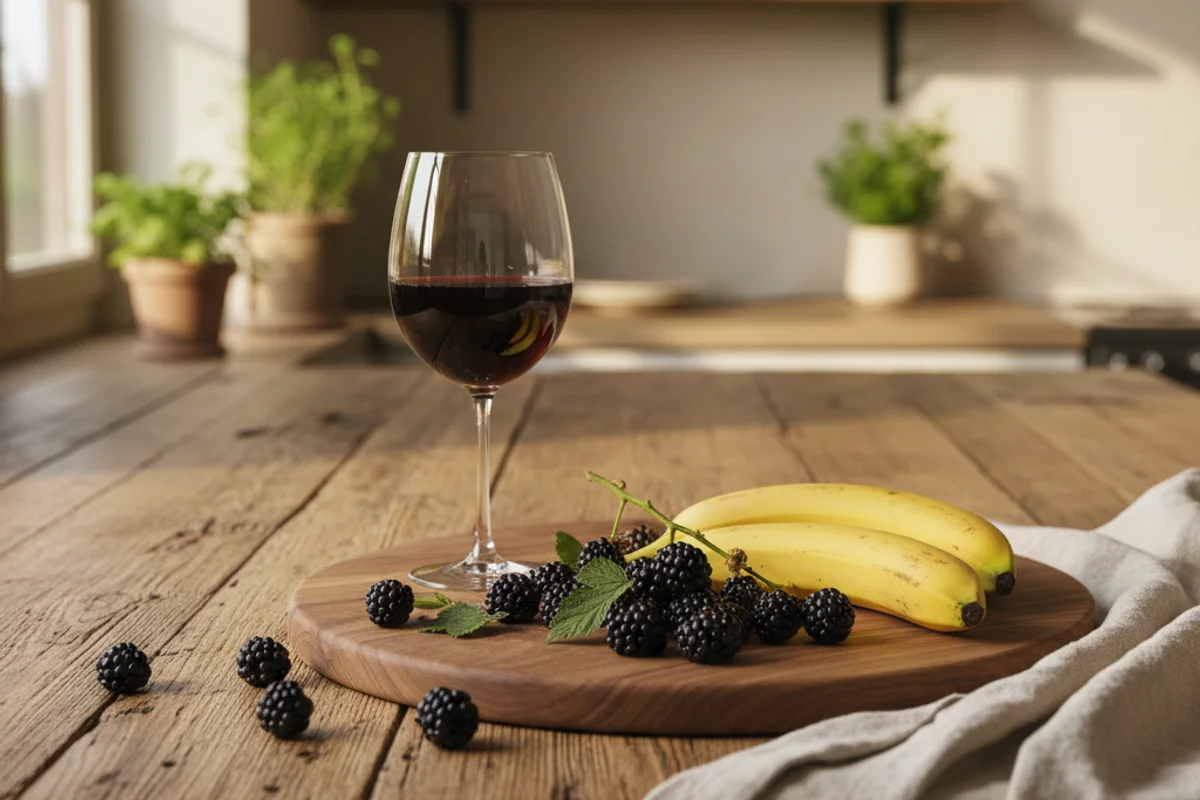
Madeira is one of the world’s most heat-stable wines — and that’s not an accident, it’s the whole point. This recipe leans into that by deliberately aging the finished wine at temperatures that would ruin almost anything else. Blackberries bring the deep, jammy fruit and tannin backbone. Bananas add body and a subtle richness that you won’t identify by name but will absolutely notice if it’s missing. The result, given enough patience, is a sweet, oxidative, complex wine that tastes far more expensive than a batch of grocery-store fruit has any right to produce.
The beginner trap: Skipping or shortening the six-month hot-aging phase — that sustained heat is what creates the caramelized, nutty Madeira character, and there’s no shortcut for it.
Ingredients
- 6 lb. blackberries, fresh or frozen
- 2 lb. ripe bananas (about 4–5 medium), peeled and thinly sliced
- 1 pt. (16 oz.) white grape juice concentrate (canned or frozen, unsweetened)
- 2 lb. granulated white sugar
- 1 gallon water, divided
- ½ tsp. pectic enzyme
- 1 packet Madeira wine yeast (Champagne or EC-1118 yeast works as a substitute)
- 1 tsp. yeast nutrient
- 1 oz. granulated activated charcoal (food-grade; available at homebrew shops or online)
Method
- Simmer the banana slices in 5 pints of water for 30 minutes, then set the pot aside — don’t discard that liquid.
- Place the blackberries in your primary fermenter and crush them by hand or with a sanitized masher.
- Strain the hot banana liquid directly over the crushed blackberries and stir in the yeast nutrient; discard the spent banana solids.
- Once the mixture cools to 70–75°F, stir in the pectic enzyme and yeast, then cover the fermenter loosely and let it ferment on the fruit pulp for two days.
- While you wait, dissolve the sugar in 1 pint of boiling water to make a simple syrup; let it cool, then seal it in a clean bottle and set it aside.
- After two days, strain the must through a fine-mesh nylon strainer, pressing the pulp gently to extract the juice; discard the solids.
- Stir in the white grape concentrate, then transfer everything to your secondary fermenter (a 1-gallon glass jug works well).
- Add enough of the reserved syrup to bring the total volume up to 7 pints, then fit an airlock.
- Check the specific gravity (SG) every day; each time it drops to 1.005 or below, stir in ½ cup of the reserved syrup — keep doing this until the syrup runs out or fermentation stops completely.
- Once fermentation has fully stopped, let the wine settle for another 3–4 days, then rack (siphon) it off the sediment into a clean jug.
- Move the jug — airlock still attached — to a very warm location holding 100–110°F (a seedling heat mat in a small insulated box works well); after two days, top up any lost volume with water.
- Keep the jug at that temperature for 6 full months, checking the airlock periodically and refilling it with water so it never runs dry.
- After 6 months, rack the wine into a clean jug, add 1 oz. of granulated activated charcoal, and seal the jug tightly with a rubber stopper or plastic wrap secured with a rubber band.
- Let it sit at room temperature for three days, then rack the wine off the charcoal and into bottles.
- Age the bottled wine for at least two years before opening.
Why this works
Real Madeira undergoes a process called estufagem — deliberate heating — that would oxidize and ruin a normal wine. Here, that’s the entire strategy. Heat accelerates the Maillard-adjacent browning reactions and controlled oxidation that produce Madeira’s signature caramel, dried fruit, and nutty notes. The bananas contribute pectin and long-chain sugars that add viscosity and mouthfeel; the pectic enzyme breaks the pectin back down so your wine clears properly rather than turning into a hazy, gelatinous mess. The charcoal treatment at the end acts as an activated filter, adsorbing harsh volatile compounds and off-flavors that the heat aging may have concentrated — leaving behind the good stuff.
Notes
Frozen blackberries are an excellent choice here and often produce better juice yield than fresh; thaw them completely before crushing. If you can’t find Madeira yeast, any high-alcohol-tolerant yeast (EC-1118, Champagne, or K1-V1116) will handle the job. For the hot-aging phase, a reptile heating mat or a brew belt combined with a small cooler can hold temperature reliably without heating an entire room.