CALENDULA WINE
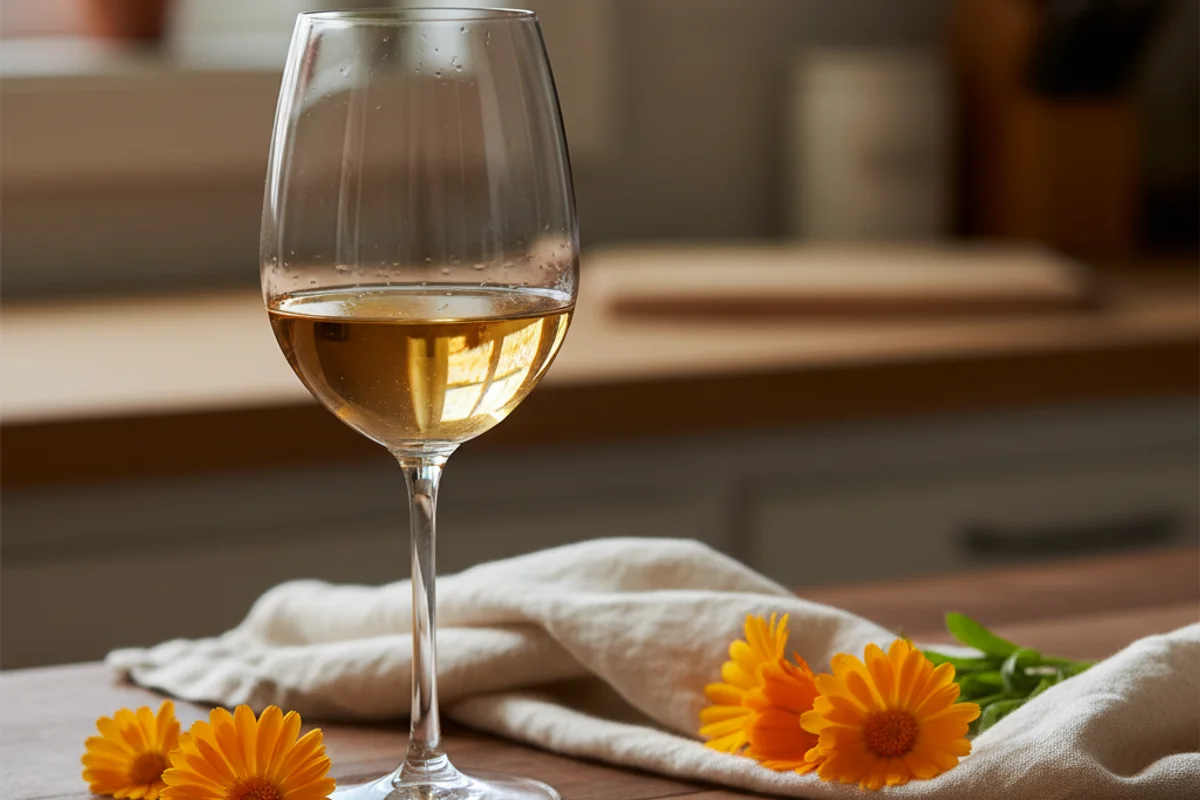
Calendula — the cheerful orange and yellow flower you probably know as pot marigold — turns out to make a surprisingly elegant wine. Dried, its petals carry a faintly earthy, honey-like warmth with subtle floral notes that fermentation lifts into something genuinely interesting. Think of it less like a flower wine and more like a golden herbal white — light-bodied, semi-sweet, and about 11% alcohol. The dried petals are sold year-round at health food stores and online as herbal tea, which means this is one flower wine you can make in January.
The beginner trap: Skipping the full stabilization step before back-sweetening — without both a Campden tablet and potassium sorbate, residual yeast will referment your sweetened wine right inside the bottle.
Ingredients
- 2 oz dried calendula petals (sold as “pot marigold” herbal tea at health food stores)
- 1 lb 14 oz granulated white sugar
- 4 tsp acid blend (available at homebrew shops; or substitute 2 tsp citric acid + 2 tsp tartaric acid)
- 7½ pts water, divided
- 1½ tsp yeast nutrient
- 2 Campden tablets (used at different stages), finely crushed
- ⅓ tsp potassium sorbate
- 1 sachet Lalvin EC-1118 yeast (or any dry champagne-style wine yeast)
Method
- Bring 3 pints of water to a boil and dissolve the sugar completely in it.
- Place the dried petals inside a nylon straining bag with 3–4 clean glass marbles to weigh it down; tie the bag shut and place it in your primary fermenter.
- Pour the hot sugar water over the petal bag, then add the remaining 4½ pints of cool water, the acid blend, and the yeast nutrient. Cover the fermenter.
- Once the must cools to room temperature, crush and dissolve one Campden tablet in a splash of water and stir it in; recover the fermenter and wait 10–12 hours.
- Activate your yeast according to the packet instructions, add it to the must, and recover the fermenter.
- Squeeze and remove the petal bag when the specific gravity (SG) drops to 1.015 or below, then transfer the wine to a sanitized 1-gallon secondary vessel and fit an airlock. Fill any overflow into a small sanitized bottle with its own airlock — you’ll use this later for topping up.
- Once the airlock has been completely still for two weeks, rack the wine into a clean secondary vessel, top up with your reserve, and refit the airlock.
- After 30 more days, dissolve the second Campden tablet and the potassium sorbate in a splash of wine, add to a clean vessel, and rack the wine onto it. Top up and refit the airlock.
- Wait another 30 days, then sweeten the wine to SG 1.006 (or to your taste) with a small sugar syrup and bottle.
- Let the bottles rest for at least two months before opening — the bouquet needs time to develop.
Why this works
Calendula petals are rich in flavonoids and carotenoids — the same pigment compounds that make the flowers orange. Hot water pulls these compounds out efficiently, which is why you steep in boiling water rather than cold. EC-1118 yeast is a strong fermenter that tolerates the relatively low nutrient environment of a petal-based must. The two-stage stabilization in Step 8 matters because potassium sorbate alone won’t stop an active fermentation — it only prevents yeast from reproducing. Pairing it with sulfite (Campden) knocks out any remaining live yeast cells first. Back-sweetening after that point is safe because the yeast population has been neutralized, not just stalled.
Notes
Dried calendula petals are easiest to find online or at stores like Whole Foods that carry bulk herbs — look for food-grade or tea-grade petals. If you can’t find acid blend, a mix of citric acid and tartaric acid (equal parts) works well as a substitute. This recipe yields just over one gallon, so keep that small overflow bottle — you’ll need it for topping up after each racking.