FEIJOA BLOSSOM WINE
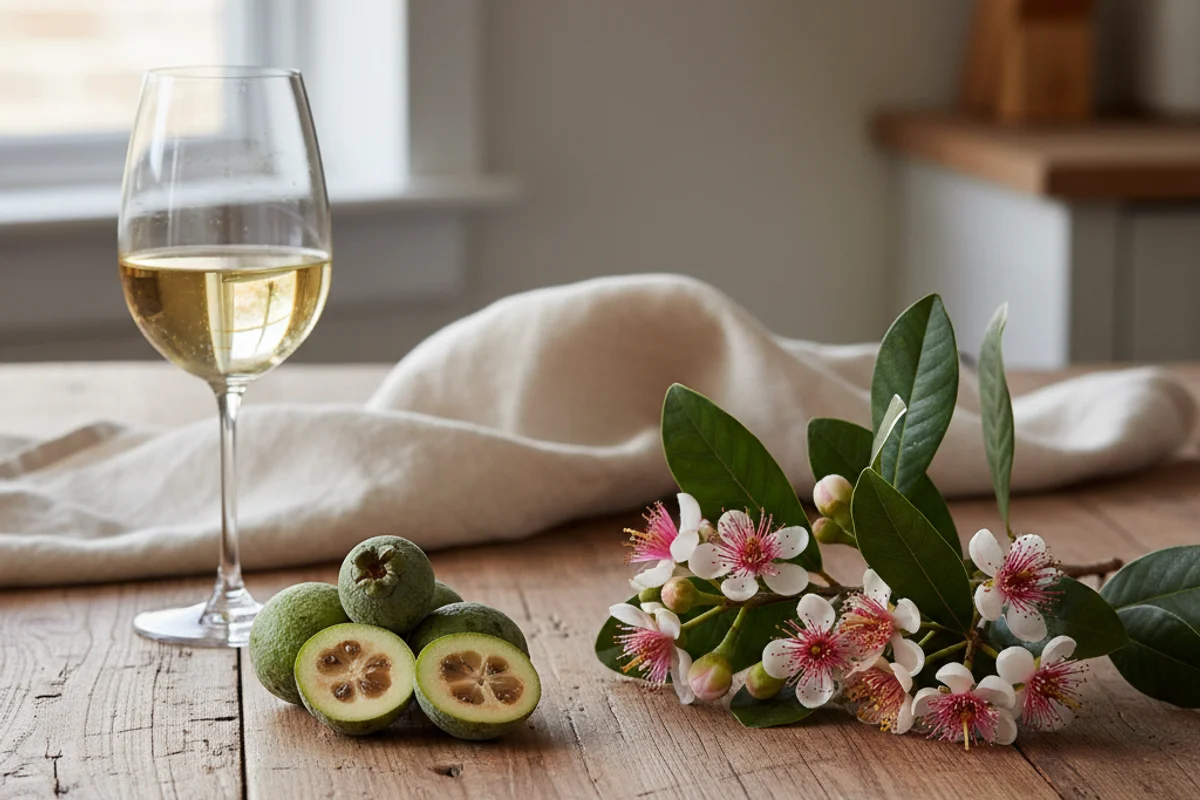
Feijoa — also called pineapple guava — is one of those plants that gives you two chances to make something remarkable. The fruit is famous for its sweet, tropical flesh. But the fleshy white petals of its blossoms? Those are edible too, and they carry a delicate floral sweetness that translates beautifully into wine. Pick the petals after the morning dew dries off, and here’s the clever part: if you leave the pistil and stamen in place, the tree still sets fruit. One tree, two crops, two wines. That’s efficient winemaking before fermentation even starts.
The beginner trap: Skipping the pectic enzyme step — or adding it while the must is still hot — leaves you with a permanently cloudy wine that no amount of racking will fix.
Ingredients
- 2 quarts loosely packed feijoa blossoms, fresh or frozen
- 2 lbs (about 4 cups) white granulated sugar
- 7 pints (3.5 quarts) water, divided
- 1 tsp acid blend (find at homebrew shops; or substitute 1/2 tsp citric acid)
- 1/8 tsp grape tannin powder (or substitute 1/4 cup strong-brewed black tea, cooled)
- 1 tsp pectic enzyme
- 1 tsp yeast nutrient
- 1 packet Côte des Blancs, Sauterne, or Hock wine yeast (or substitute Lalvin 71B)
Method
- Place the blossoms in a nylon straining bag and set it in your primary fermenter. Put 2 quarts of water on to boil.
- Stir the sugar into the boiling water until fully dissolved, then pour the hot syrup directly over the flower bag in the primary.
- Add the acid blend, tannin, and yeast nutrient. Push the bag down, then cover the primary loosely and stir every 30 minutes while the must cools.
- Once the must reaches room temperature (around 70°F), stir in the pectic enzyme and the remaining cold water. Cover and let it rest for 10–12 hours.
- Activate your yeast according to the packet instructions, then stir it into the must. Cover the primary again.
- Stir the must twice a day for 7 days, pushing the bag down each time to extract flavor from the petals.
- After 7 days, lift the bag and squeeze out as much liquid as you can, then discard the spent petals. Leave the must covered for 3 more days without stirring.
- Rack the wine into a clean secondary fermenter (a 1-gallon glass jug works well) and fit an airlock.
- After 45 days, rack again into a clean vessel, top up to minimize headspace, and refit the airlock. Repeat every 45 days until the wine runs clear and leaves zero sediment behind.
- Rack into bottles and let it rest at least a few weeks before opening.
Why this works
Feijoa petals are loaded with aromatic compounds, but they’re also packed with pectin — the same stuff that makes jam gel. Pectin clouds wine and doesn’t settle out on its own. Pectic enzyme breaks those pectin chains apart, giving you a clear, bright finished wine instead of a murky one. The catch is that pectic enzyme is a protein, and heat destroys proteins. Add it too soon, while the must is still warm, and you’ve denatured it before it could do anything useful. Waiting until the must drops to room temperature keeps the enzyme intact so it can do its job during that pre-fermentation rest period.
Notes
Frozen feijoa blossoms work just as well as fresh — freeze them in a single layer first, then transfer to a bag. If feijoa trees don’t grow in your area, this recipe is genuinely hard to replicate with a substitute, since the blossoms are the whole point; consider it a reason to seek out a local grower or farmers market. If your finished wine tastes thin or sharp, a small addition of honey at back-sweetening can round it out nicely.