GORSE WINE
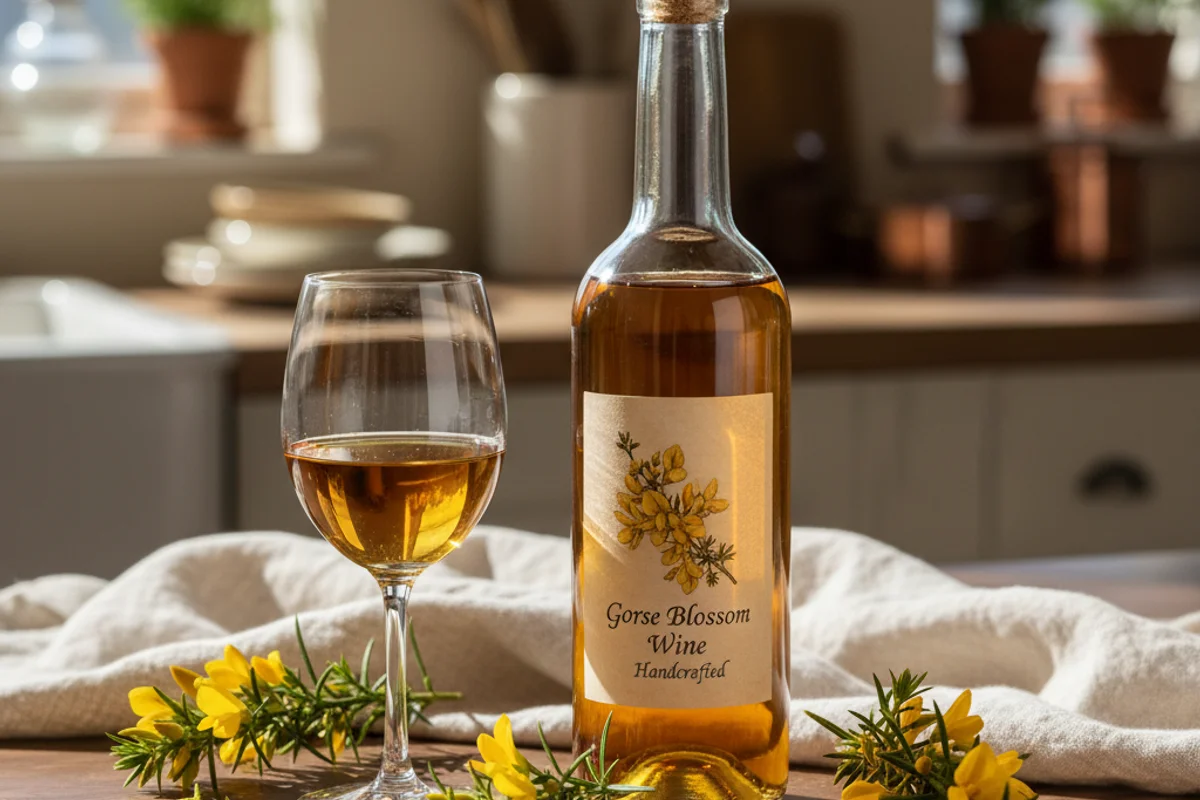
Imagine a shrub that smells like a coconut bakery exploded across a hillside. That’s gorse in full bloom — a spiny, invasive plant that somehow produces small golden flowers with one of the most surprisingly tropical scents in the plant kingdom. Those flowers, when fermented with citrus and raisins, build a light, fragrant wine that tastes nothing like anything you’d pull off a store shelf. It’s floral, subtly sweet, and genuinely weird in the best possible way. Picking the blooms is the hard part. Everything after that is straightforward.
The beginner trap: Rushing the process — gorse wine needs a full series of rackings and at least six months of bottle aging before the floral character settles into something worth drinking.
Ingredients
- 12 cups gorse flowers, freshly picked
- 7 pints water, divided
- 1½ lbs granulated white sugar, divided
- 1½ cups seedless white raisins, chopped (golden raisins work fine)
- 2 oranges
- 2 lemons (or ¼ oz citric acid)
- ⅛ tsp grape tannin (or 1 cooled cup of strong black tea)
- 1 tsp yeast nutrient
- 1 packet Lalvin EC-1118 yeast (or any champagne yeast)
Method
- Place the gorse flowers into your primary fermenter (a food-safe bucket works well).
- Combine half the water, half the sugar, and the chopped raisins in a pot and boil for 1–2 minutes, then pour the hot liquid over the flowers.
- Use a vegetable peeler to remove thin strips of zest from the oranges and lemons — no white pith — and add the zest to the fermenter.
- Squeeze the juice from the oranges and lemons and add it to the fermenter; discard the pulp and seeds.
- Add the grape tannin and stir everything together well.
- Pour in enough cold water to bring the total volume to 1 gallon.
- Once the must cools to 90°F or below, activate your yeast according to the packet and stir it in along with the yeast nutrient; cover the fermenter.
- Ferment for 3 days at room temperature, stirring twice daily.
- After 3 days, add the remaining sugar, stir until fully dissolved, re-cover, and continue stirring twice daily until fermentation slows or the specific gravity drops below 1.020.
- Strain the must through a fine mesh strainer or cheesecloth into a 1-gallon glass jug (secondary fermenter) and fit an airlock; move it to a warm spot.
- Rack into a clean jug after 30 days, then again once the wine runs clear; wait another month and rack one more time.
- Stabilize with potassium sorbate and potassium metabisulfite, wait 30 days, then sweeten to a specific gravity of 1.004–1.006 if desired.
- Wait an additional 30 days, rack into bottles, and age at least 6 months before opening.
Why this works
Gorse flowers hold volatile aromatic compounds — including those responsible for the coconut scent — that are water-soluble and extract well during the primary ferment. The raisins contribute unfermentable sugars, trace minerals, and a small amount of natural grape flavor that rounds out the thin body flowers alone would produce. Citrus juice supplies acid, which keeps fermentation healthy and helps the wine stay bright and stable long-term. EC-1118 (a champagne yeast) is chosen here because it ferments cleanly and tolerates higher alcohol levels, giving you a dry base that’s easy to sweeten to taste at the end without risking a re-fermentation in the bottle.
Notes
Grape tannin is sold at homebrew shops, but a cup of strong brewed black tea (cooled and added at step 5) is a reliable grocery-store swap. If you’re outside gorse’s range, this recipe works with elderflowers at the same volume — same floral-wine logic applies. Wear thick gloves when picking; the spines are serious.