HONEYSUCKLE WINES
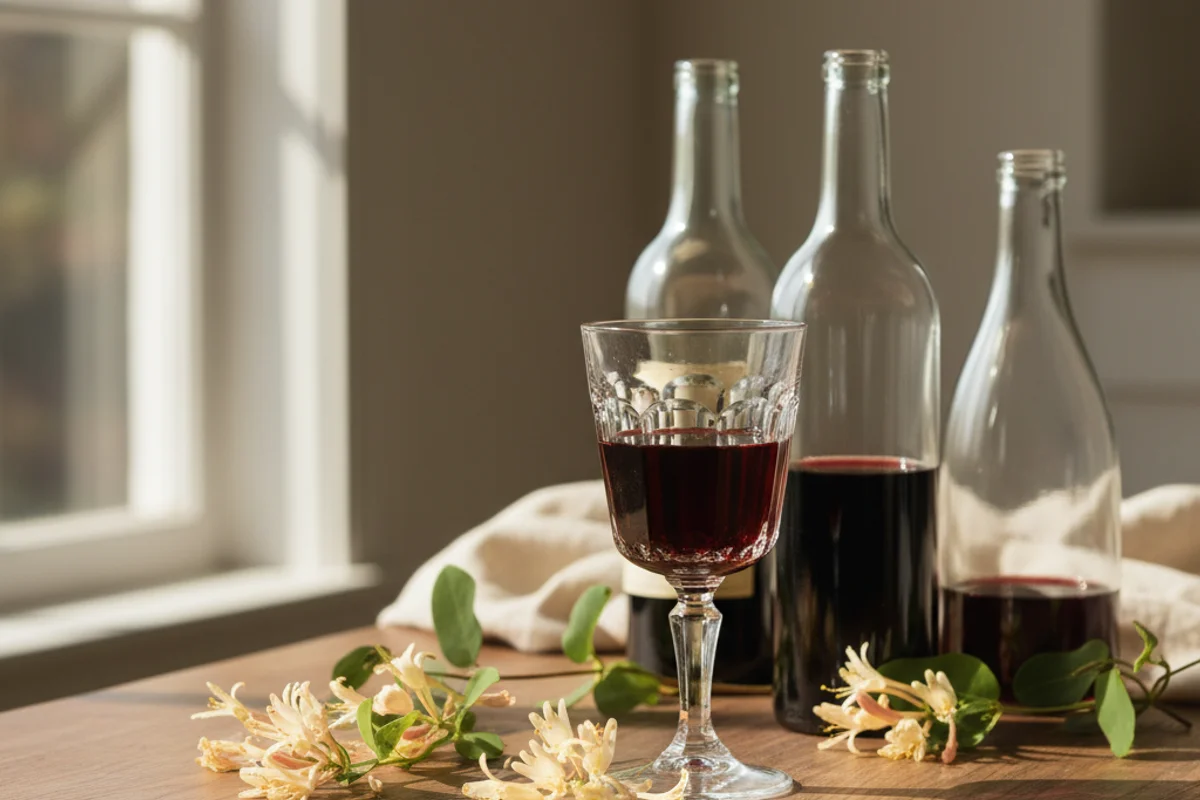
Honeysuckle blossoms smell like a summer evening distilled into a single breath. That scent — sweet, faintly tropical, almost honey-like — can survive fermentation if you treat the flowers right. These two recipes take the same base and split at a fork: one is clean and delicate, the other gets a citrus backbone that keeps the wine from tasting like perfume-scented water. Both reward patience. Neither will taste like much at six months. At twelve, they’ll surprise you.
The beginner trap: Picking too late in the day or after rain dilutes the aromatic oils in the petals, leaving you with a wine that smells like nothing in particular.
Recipe 1 — Classic Honeysuckle
Ingredients
- 6 cups honeysuckle flower petals, lightly packed (fresh)
- 7½ pints (about 15 cups) water, divided
- 2 lbs granulated white sugar
- 3 tsp acid blend (or substitute 3 tbsp fresh lemon juice)
- 1 Campden tablet, crushed
- ⅛ tsp grape tannin powder (or substitute 1 tbsp strong plain black tea)
- 1 tsp yeast nutrient
- 1 packet Champagne or dry white wine yeast
Recipe 2 — Honeysuckle Citrus
Ingredients
- 6 cups honeysuckle flower petals, lightly packed (fresh)
- 7½ pints (about 15 cups) water, divided
- 2½ lbs granulated white sugar
- 2 lemons, or 1 lemon and 1 orange — zest thin-peeled, fruit juiced
- 1 Campden tablet, crushed
- ⅛ tsp grape tannin powder (or substitute 1 tbsp strong plain black tea)
- 1 tsp yeast nutrient
- 1 packet Champagne or dry white wine yeast
Method
(Steps 1–3 apply to both recipes. Recipe 2 notes are in brackets.)
-
Pick flowers on a dry morning shortly after they open. Pull the petals free and discard all stems and green flower bases. Rinse petals gently under cold water.
-
Place petals [and citrus peel for Recipe 2] in a 2-quart saucepan with a lid. Add 1 quart of the water, bring to a bare simmer, then remove from heat, cover, and steep for 3 hours.
-
While the petals steep, bring the remaining water to a boil and stir in all the sugar until fully dissolved. Remove from heat, cover, and let cool to room temperature.
-
Strain the flower liquid into your primary fermenter, pressing the petals lightly to extract liquid. Discard the spent petals [and peel].
-
Add the cooled sugar water to the primary. [For Recipe 2, add the citrus juice here.]
-
Stir in the acid blend, crushed Campden tablet, tannin, and yeast nutrient until the Campden fully dissolves. Cover the primary well and leave it alone for 24 hours.
-
Activate your yeast according to the packet directions, then pitch it into the must. Re-cover the primary loosely.
-
Stir the must once daily until the specific gravity (SG) drops to 1.015.
-
Rack the wine off the sediment into a clean secondary fermenter and fit an airlock.
-
After 30 days, rack again into a freshly sanitized secondary, top up to minimize headspace, and refit the airlock. Store in a dark, cool place.
-
Rack once more at 3 months and again at 6 months if sediment has built up. At the 6-month mark, stabilize the wine, sweeten to taste if desired, then rack into bottles.
-
Store bottles in a dark place for at least 6 more months before opening. The wait is not optional — it is the recipe.
Why this works
Honeysuckle petals hold their aroma in volatile organic compounds — mostly linalool and related terpenes. A gentle simmer rather than a hard boil protects those compounds from evaporating before they transfer to the water. Covering the pan during the steep keeps them from escaping as steam. Tannin, which honeysuckle petals almost entirely lack, gets added back in because wine without any tannin feels flat and ages poorly — it needs that slight structural grip. Acid blend (or lemon juice) drops the pH into the range where yeast thrives and spoilage organisms struggle, usually between 3.2 and 3.5.
Notes
Fresh flowers are strongly preferred here — frozen honeysuckle blossoms lose most of their aroma during the freeze-thaw cycle and will produce a noticeably thinner wine. If acid blend is hard to find at your local homebrew shop, 3 tablespoons of fresh lemon juice is a workable substitute for Recipe 1 (Recipe 2 already supplies citrus acid). Grape tannin powder is available at homebrew retailers; if you skip it entirely, expect a softer, shorter-lived wine.