JAM & FRUIT SPREAD WINE
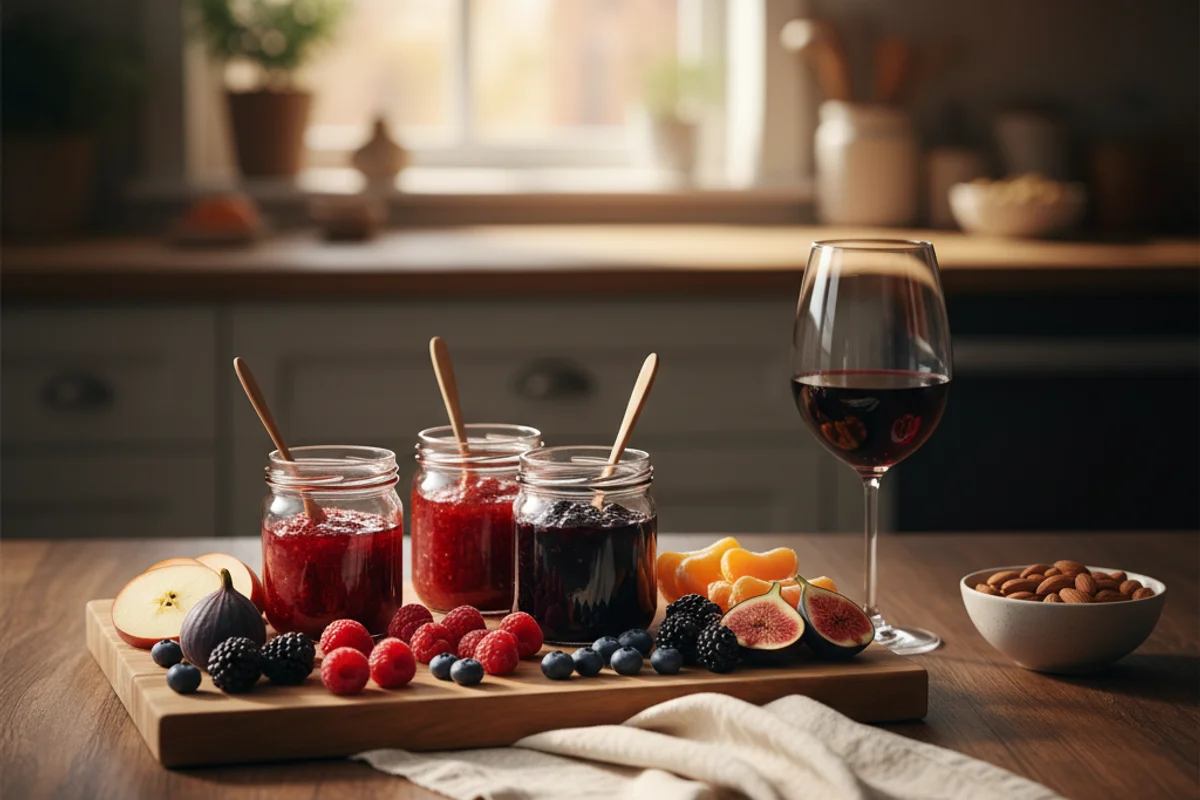
That jar of blackberry preserves sitting in the back of your fridge isn’t just a toast topping — it’s a head start on a bottle of wine. Fruit spreads are already cooked, already sweetened, and already bursting with concentrated flavor. Jam wine can range from a bright, almost candy-like sipper to a deep, jammy red that drinks like a rustic country wine. The flavor you start with is pretty much the flavor you’ll end up with, just fermented dry and stretched into something genuinely complex. Pick your favorite spread and let it do the heavy lifting.
The beginner trap: Using a commercial spread that contains potassium sorbate or sodium benzoate — both are preservatives that will prevent your yeast from fermenting, and your wine will never get off the ground.
Ingredients
- 4 lbs (about 36 fl oz) jam, preserves, fruit butter, conserves, or marmalade — any flavor
- Sugar, as needed to reach a specific gravity of 1.090 (roughly 1–2 cups, depending on spread)
- 3 tsp powdered pectic enzyme
- 2–3 tsp citric acid (see Notes)
- ½ tsp powdered grape tannin (find it at homebrew shops, or substitute 1 cup strong-brewed unsweetened black tea)
- Water to make 1 gallon total
- 1¼ tsp yeast nutrient
- 1 packet general-purpose wine yeast
Method
- Bring 3 quarts of water to a boil, remove from heat, and stir in all of the fruit spread until fully dissolved. Cover and let cool to room temperature, about 4–5 hours.
- Transfer the cooled liquid to your primary fermenter and stir in the pectic enzyme. Cover and let it sit for 72 hours (3 full days).
- Strain the liquid through a fine mesh strainer or cheesecloth into a pot, discarding any solids. Bring the strained liquid to a boil and hold it there for 5 minutes, then remove from heat.
- Add the sugar, citric acid, grape tannin, and yeast nutrient to the empty primary fermenter. Pour the hot liquid over the dry ingredients and stir until the sugar is fully dissolved.
- Cover and let cool to room temperature. While it cools, prepare your yeast starter according to the packet instructions.
- Once cool, check the specific gravity with a hydrometer and adjust with additional sugar or water to reach 1.090. Transfer to your secondary fermenter (a 1-gallon glass jug works great) but do not top it off yet.
- Add the activated yeast starter, then cover the opening with a paper towel held on with a rubber band. After 3 days, swap the paper towel for an airlock.
- Once vigorous bubbling slows down (around day 5–7), top up the fermenter with water or a similar plain wine to minimize headspace.
- After 30 days, rack the wine into a clean vessel, add sulfite (¼ tsp potassium metabisulfite per gallon), top up, and reattach the airlock.
- Rack again every 30 days, adding sulfite every other racking, until no new sediment forms and the wine runs clear.
- If the wine is still hazy after 60 days, stir in 1 additional teaspoon of pectic enzyme and wait 2 weeks. Repeat once more if needed.
- Once clear, stabilize with potassium sorbate and potassium metabisulfite, sweeten to taste if desired, wait 30 days, then bottle. Age at least 6 months before drinking.
Why this works
Fruit spreads are loaded with pectin — the same natural plant starch that makes jam gel on your toast. In a wine, pectin causes a stubborn, protein-like haze that won’t drop out on its own no matter how long you wait. Pectic enzyme (pectinase) breaks those long pectin chains into shorter fragments that can clump together and fall to the bottom of the fermenter. That’s why this recipe uses pectic enzyme twice: once before fermentation to start breaking things down, and again after fermentation if the wine is still cloudy. Alcohol actually makes pectin harder to break down, so the post-fermentation dose needs to be larger and work longer than you might expect.
Notes
Use 2 tsp citric acid for high-acid fruits like citrus, raspberry, or blackcurrant; use 3 tsp for lower-acid fruits like peach, pear, or fig. If you’re using a peach, plum, or greengage spread, plan to add extra pectic enzyme from the start — those fruits are especially high in pectin. Always read the label on commercial spreads and skip any that list potassium sorbate, sorbic acid, sodium benzoate, or benzoic acid in the ingredients.