QUINCE WINE
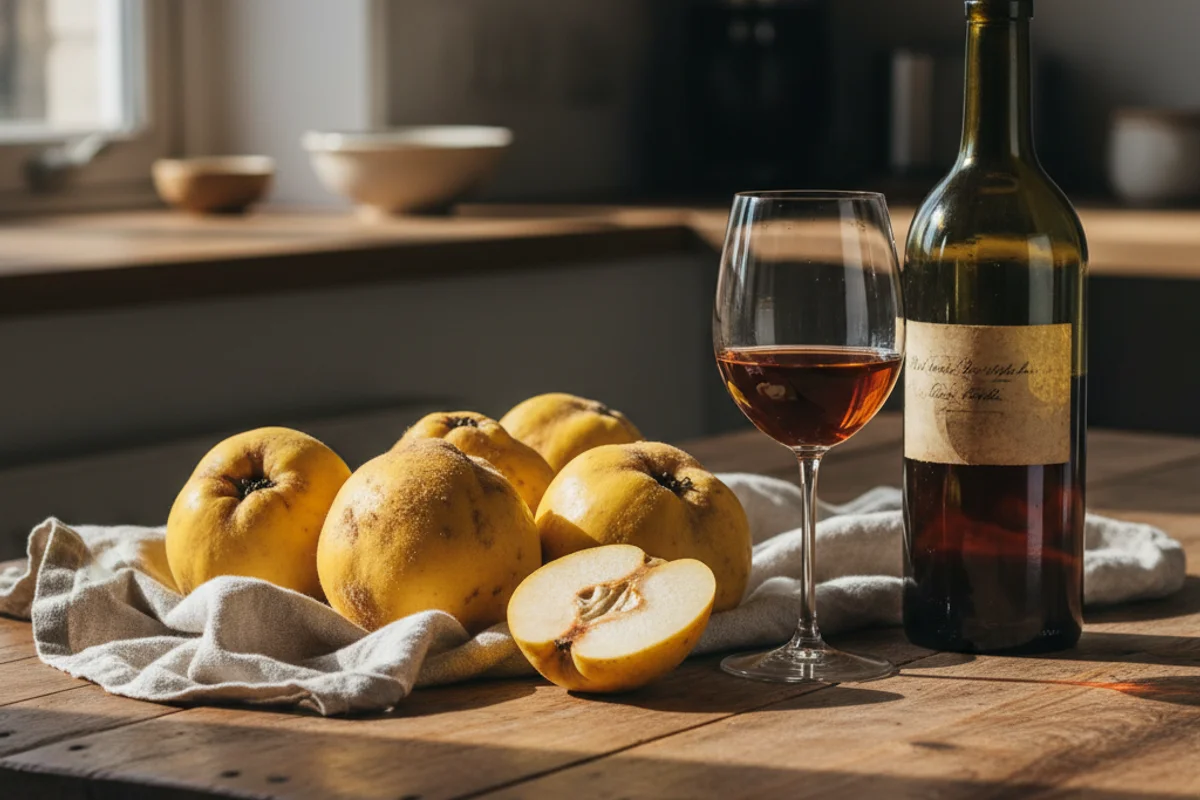
Quince is the fruit world’s contrarian. It looks like a lumpy yellow pear, smells like tropical flowers and honey, and will pucker your face raw if you bite into one fresh. Cook it, though, and something remarkable happens — the harsh tannins soften, the aroma deepens, and you get a flavor that sits somewhere between apple, pear, and guava with a floral backbone unlike anything else in the orchard. That complexity translates beautifully into wine, producing a bottle with a bold, distinctive character that rewards patience. This is not a quick-turnaround project. Plan to wait one to two years before it really sings.
The beginner trap: Squeezing the straining bag to speed things up will release excess pectin and starch into your must, and your wine will stay cloudy no matter what you try.
Ingredients
- 20 quinces, grated (fresh; frozen pulp can work — see Notes)
- 1¾ lbs (795 g) finely granulated white sugar
- 7 pints (3.3 L) water
- 2 lemons, zest and juice only
- 1 tsp pectic enzyme
- 1 tsp yeast nutrient
- 1 packet Montrachet yeast (faster ferment) or Champagne yeast (slower but better suited to quince’s tartness)
Method
- Grate the quinces as close to the core as possible, leaving the seeds behind entirely.
- Combine the grated pulp with the water in a pot and boil for exactly 15 minutes — set a timer, because overcooking will cause clarification problems later.
- Pour the hot liquid through a nylon straining bag directly over the sugar in your primary fermenter, letting the bag hang and drip drain on its own; do not press or squeeze it.
- Stir until the sugar fully dissolves, then add the lemon zest, lemon juice, and yeast nutrient.
- Cover the fermenter with a clean cloth and let the must cool to room temperature (around 65–75°F / 18–24°C).
- Stir in the pectic enzyme, re-cover, and leave it alone for 12 hours.
- Sprinkle in the yeast, re-cover, and move the fermenter to a warm spot for 48 hours.
- Strain the must into a 1-gallon secondary fermenter and fit an airlock.
- Do not rack until the wine has cleared on its own; once clear, rack every 60 days until the specific gravity reaches 0.990 (fully dry).
- Stabilize the wine, wait 10 days, then rack into bottles.
Why this works
Quince is loaded with pectin — the same stuff that makes jam gel. When you boil the fruit, pectin leaches into the water. If you squeeze the bag, you push even more of it through, and pectin in wine creates a haze that pectic enzyme alone may struggle to fix. By letting the bag drip drain, you leave the worst of it behind. The pectic enzyme you add later breaks down whatever pectin did make it into the must, keeping the path to a clear wine open. Boiling for exactly 15 minutes is also a balancing act: enough heat to extract flavor and color, not so much that you convert starches into compounds that scatter light and cloud your finished wine permanently.
Notes
Quinces can be hard to find at a standard grocery store — check Latin or Middle Eastern markets, where they are often sold in season (fall). Frozen quince pulp works as a substitute; thaw it completely and skip the grating step, but still boil it for the full 15 minutes. This recipe scales linearly: double every ingredient for a 2-gallon batch.