ROSELLE WINE
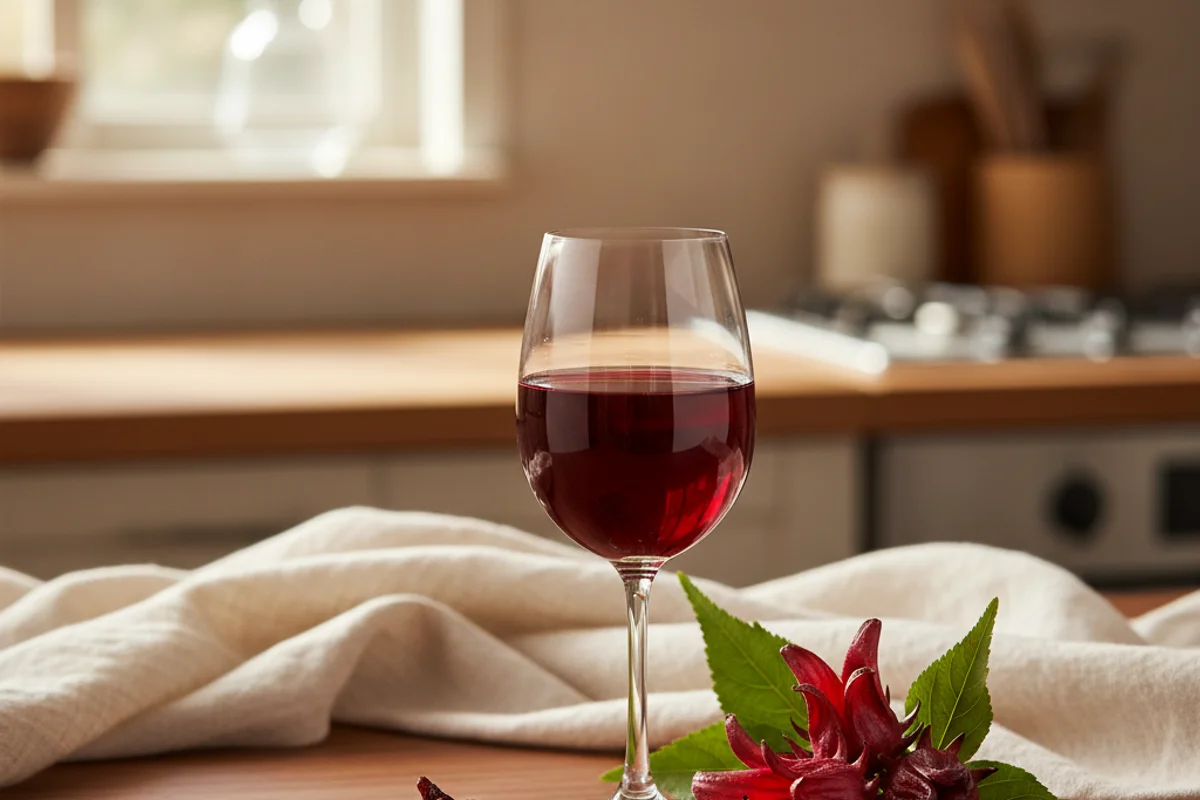
If you’ve ever brewed a cup of hibiscus tea and thought, “this needs to be stronger and last longer,” roselle wine is your answer. Hibiscus sabdariffa produces tart, cranberry-red calyces that ferment into a striking, ruby-colored wine with bright acidity and floral depth. It’s the kind of wine that surprises people — nobody expects something that color to taste that complex. Pick your flowers in the mid-morning once the dew has dried, and move fast. Fresh roselle waits for no one.
The beginner trap: Skipping the daily squeeze of the straining bag means you’ll leave most of the color and flavor locked inside the flowers and raisins instead of in your wine.
Ingredients
- 3½ lbs (1.6 kg) sugar
- 1 lb (450 g) fresh roselle blossoms and bracts (fresh or frozen)
- ½ lb (225 g) golden raisins or sultanas, finely chopped
- 7 pints (3.3 L) water
- 1½ tsp acid blend (or substitute 1½ tsp lemon juice per tsp as a rough stand-in)
- 1 tsp yeast nutrient
- 1 packet Côte des Blancs wine yeast (or any dry white wine yeast)
Method
- Combine the water and sugar in a pot over medium-high heat, stirring until the sugar fully dissolves, then bring to a boil.
- Place the roselle blossoms, bracts, and chopped raisins into a nylon straining bag, tie it closed, and set it in your primary fermenter.
- Pour the boiling sugar-water over the bag and stir in the acid blend and yeast nutrient. Do not add yeast yet.
- Cover the fermenter and let everything cool to room temperature, roughly 65–75°F (18–24°C).
- Activate your yeast according to the packet instructions, then add it to the must and re-cover the fermenter.
- Squeeze the straining bag once a day for 7–8 days, until vigorous fermentation slows down.
- Give the bag a final firm squeeze to pull out every last bit of flavor, then discard the spent solids.
- Let the liquid settle overnight, then rack it into a clean secondary fermenter, top up to minimize headspace, and fit an airlock.
- After 30 days, rack into another clean secondary and refit the airlock. Repeat this every 30 days until the wine runs clear.
- Wait an additional 2 months after the wine clears, then rack one final time and stabilize with potassium sorbate and potassium metabisulfite.
- Wait 10–14 days, then bottle. It’s drinkable young, but six months of aging rounds out the edges considerably.
Why this works
Roselle calyces are loaded with anthocyanins — the same pigment family that makes red cabbage purple and blueberries blue. These compounds are both the color source and a major flavor contributor, bringing that signature tart, cranberry-like bite. Because anthocyanins are water-soluble, hot water extracts them efficiently right from the start. The golden raisins aren’t just filler; they provide natural sugars, body-building tannins, and trace nutrients that help the yeast do its job cleanly. Côte des Blancs yeast is a low-foaming, low-alcohol-stress strain that preserves delicate floral aromatics rather than blowing them off during a hard fermentation — a smart match for a flower-based wine.
Notes
Frozen roselle calyces work just as well as fresh and are far easier to source; check Latin American or Caribbean grocery stores, where the dried or frozen version is often sold as jamaica (pronounced ha-MY-ka). If you can’t find acid blend, a measured addition of citric acid (available online or at homebrew shops) is a direct substitute. If the finished wine tastes thin, a small addition of grape tannin powder at the stabilization step can add structure.