SUNFLOWER WINES
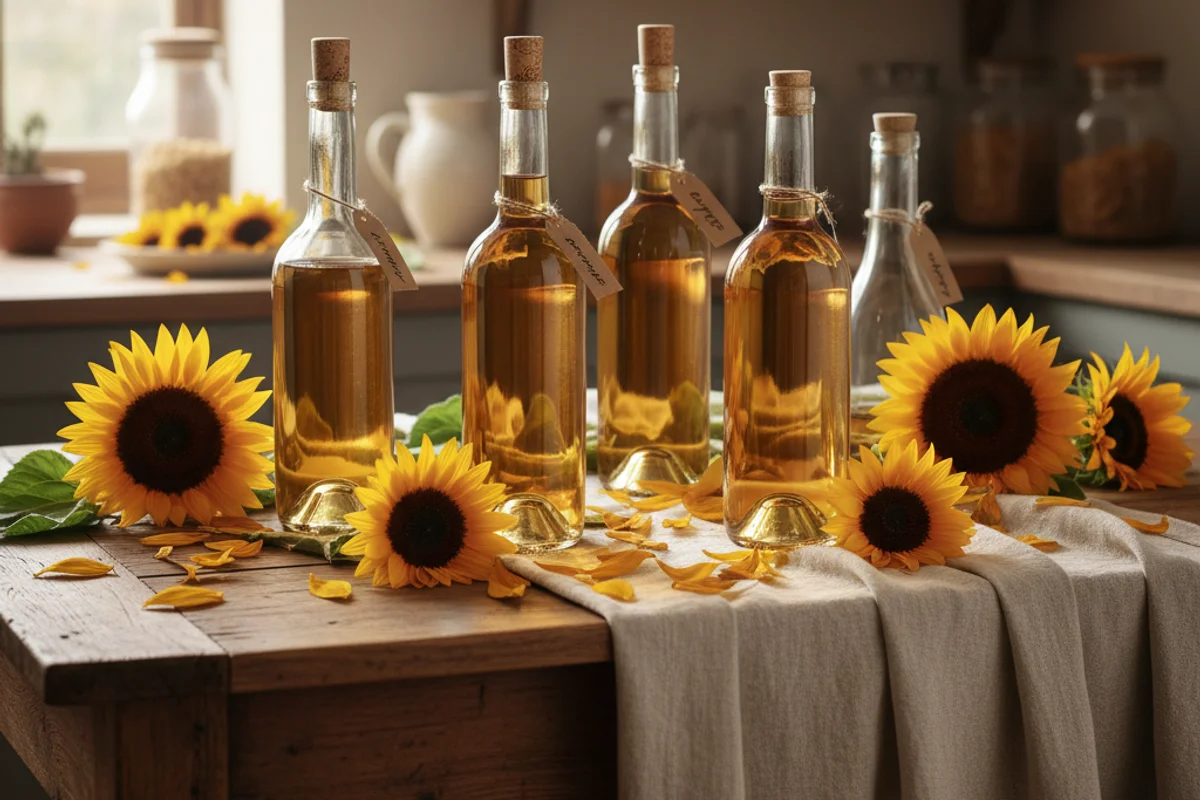
Sunflower petals don’t taste like much on their own — they’re mild, faintly earthy, and a little grassy. That’s exactly what makes them such a good winemaking canvas. Citrus zest and juice punch up the aroma, white grape juice concentrate builds body, and the right yeast ties it all together into something genuinely surprising. Think light, floral, and dry with a honey-gold color that looks like summer in a glass. This is country-style winemaking at its most creative.
The beginner trap: Using any part of the sunflower other than the petals — the green base, the central disk, or the stem — will push bitter, off-flavors into your wine that no amount of aging will fix.
Ingredients
Version 1 — Hot-Steep Method (with citrus zest)
- 2 quarts sunflower petals, freshly picked and rinsed
- 1 can (11 oz) Welch’s 100% White Grape Juice frozen concentrate
- 1 lb 10 oz granulated sugar
- 2 lemons, juice and zest
- 3 oranges, juice and zest
- 1 tsp yeast nutrient
- ¼ tsp pectic enzyme
- ¼ tsp wine tannin (or 1 cup plain unsweetened black tea as a substitute)
- 6½ pints water
- Côtes-du-Rhône or Hock wine yeast (or a general-purpose white wine yeast like Lalvin 71B)
Version 2 — Cold-Steep Method (juice only, no zest)
- 2 quarts sunflower petals, freshly picked and rinsed
- 1 can (11 oz) Welch’s 100% White Grape Juice frozen concentrate
- 1 lb 10 oz granulated sugar
- 2 lemons, juice only
- 3 oranges, juice only
- 1 tsp yeast nutrient
- ¼ tsp pectic enzyme
- ¼ tsp wine tannin (or 1 cup plain unsweetened black tea)
- 6½ pints water
- White Burgundy wine yeast (or Lalvin 71B)
Method
Version 1 — Hot-Steep
- Rinse the sunflower petals well and set aside. Zest the lemons and oranges, then juice them and set both aside separately.
- Bring the water to a boil. Place the petals and citrus zest together in a nylon straining bag, tie it closed, and put it in your primary fermenter.
- Pour the boiling water directly over the bag. Cover the fermenter and squeeze the bag several times a day for 3 days.
- After 3 days, drain and squeeze the bag thoroughly to pull out all the liquid, then remove and discard it.
- Stir the sugar into the liquid until fully dissolved. Add the grape juice concentrate, citrus juice, yeast nutrient, pectic enzyme, and tannin. Stir well, cover, and let it rest for 10–12 hours.
- Activate your yeast according to the packet instructions, then add it to the must. Cover the fermenter.
- Stir twice daily for 5 days, then transfer the wine to a glass secondary fermenter (carboy) and fit an airlock.
- Once the wine clears, rack it into a clean carboy, add 1 crushed Campden tablet, top up to minimize headspace, and refit the airlock.
- Rack again every 2 months for 6 months total, adding a crushed Campden tablet at the middle racking and a stabilizer (potassium sorbate) at the final racking.
- Wait one more month, then rack into bottles and age for at least 12 months before opening.
Version 2 — Cold-Steep
- Combine the sugar, grape juice concentrate, citrus juice, yeast nutrient, pectic enzyme, and tannin in your primary fermenter with the water. Stir until the sugar is fully dissolved.
- Cover and rest for 10–12 hours. Activate your yeast and add it to the must, then cover again.
- Stir twice daily until the vigorous bubbling slows — usually around 3–5 days.
- Meanwhile, rinse your sunflower petals. Load them into a nylon straining bag weighted with a dozen sanitized glass marbles, tie it closed, and submerge it in the fermenting must.
- Gently squeeze and dunk the bag several times a day for 5 days, then drain and squeeze the bag out completely before removing it.
- Transfer the liquid to a glass carboy and fit an airlock. After 2 weeks, rack into a clean carboy, top up, and refit the airlock.
- Once the wine clears fully, wait 2 more weeks, then rack into a carboy containing 1 crushed Campden tablet.
- Rack every 2 months for 6 months, adding a Campden tablet every other racking and stabilizing with potassium sorbate at the last one.
- Wait one final month, then bottle. Age 6–12 months for best results.
Why this works
Sunflower petals are low in sugar, acid, and tannin on their own — basically a blank slate. That’s why this recipe leans hard on supporting ingredients. The frozen white grape juice concentrate adds fermentable sugar, body, and mild grape character without overwhelming the floral notes. Citrus juice drops the pH into the 3.0–3.5 range where yeast thrive and spoilage bacteria struggle. Pectic enzyme breaks down plant cell walls, which releases more flavor compounds and prevents a stubborn pectin haze from clouding your finished wine. Tannin gives the wine structure and helps it age. The two steeping methods — hot and cold — pull flavor differently: hot water extracts faster but can cook off some aromatics, while the cold steep takes longer but preserves more of the petal’s delicate character.
Notes
- Pull petals only from the outer ring of the flower head — no green parts, no stem, no central disk. The green parts are bitter and will ruin the batch.
- Wine tannin powder is available at homebrew shops; if you can’t find it, steep 1 cup of strong plain black tea and use that instead.
- Lalvin 71B is a widely available, grocery-store-friendly yeast that works well here if specialty wine yeasts aren’t accessible locally.