WINE FROM MUSCAT GRAPE JUICE
Muscat juice smells like someone bottled a flower garden, a fruit stand, and a warm summer evening all at once. That signature perfume — floral, honeyed, faintly orange-blossom — comes through in the finished wine with almost zero effort on your part. This is one of those rare cases where the raw ingredient is so expressive that your main job is simply to not get in the way. Serve it cold, dry or slightly sweet, and watch people ask what winery made it.
The beginner trap: Skipping the Campden tablet rest before adding pectic enzyme — doing both at the same time can neutralize the enzyme before it has a chance to break down the pectin that would otherwise leave your wine cloudy.
Ingredients
- 1 gallon Muscat grape juice (fresh-pressed, store-bought, or frozen concentrate reconstituted)
- Granulated white sugar, as needed, to adjust starting gravity (likely none required)
- ½ tsp pectic enzyme
- 1 Campden tablet (potassium metabisulfite), finely crushed and dissolved
- ⅔ tsp yeast nutrient
- 1 packet wine yeast suited to aromatic whites (Red Star Côte des Blancs or Premier Blanc are widely available substitutes for specialty Muscat yeast)
- 1 additional Campden tablet (for later stabilization)
- ⅓ tsp potassium sorbate (for stabilization before sweetening)
Method
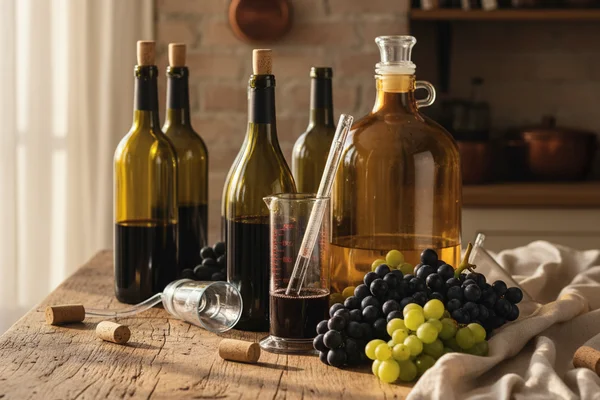
- Check the specific gravity of your juice with a hydrometer. Adjust to 1.095 if you plan to top up with water, or 1.088 if you plan to top up with finished Muscat wine.
- Pour the juice into your primary fermentation vessel. Dissolve one crushed Campden tablet in a small amount of juice, stir it in, then cover the vessel with a sanitized cloth and leave it alone for 10–12 hours.
- Add the pectic enzyme, re-cover, and wait another 8–10 hours. This two-stage wait is intentional — the Campden needs to do its job before the enzyme gets to work.
- Stir in the yeast nutrient, then add your activated yeast. Cover the vessel again.
- Monitor the specific gravity daily. When it drops to 1.015 or below, transfer the wine to a sanitized carboy (secondary fermentation vessel) and fit an airlock.
- Wait until fermentation is completely finished and the airlock has shown no activity for two full weeks. Then rack into a clean carboy, top up to minimize headspace, and refit the airlock.
- Wait 4–6 more weeks. Dissolve one Campden tablet and the potassium sorbate in a small amount of wine, add the mixture to a clean carboy, and rack the wine onto it. Top up and refit the airlock.
- Wait 30 days, then sweeten to taste if desired. Bottle the wine and wait at least two months before opening — the aroma needs time to fully develop in the bottle.
Why this works
Muscat juice is naturally low in acid, which means fermentation moves smoothly but the wine can taste flat if you push sweetness too high without balance. The pectic enzyme breaks down long-chain pectin molecules in the juice that would otherwise form a haze you cannot filter out by waiting alone. Campden (sulfite) goes in first because it knocks back any wild yeast or bacteria that could compete with your chosen yeast — and those wild microbes also consume sulfite, so adding pectic enzyme right alongside Campden means the enzyme gets hit before it can do its job. The potassium sorbate added at stabilization prevents any surviving yeast from restarting fermentation after you sweeten the wine. Think of it as a “do not restart” signal sent directly to the yeast cells.
Notes
If you are starting from whole grapes rather than juice, expect to crush and press roughly 12–13 pounds of fruit to get one gallon of juice — avoid any juicer that grinds the seeds, since that releases bitter tannins. Frozen Muscat juice or a high-quality white grape juice concentrate from a homebrew shop both work well if fresh juice is out of season or out of reach.