Winemaking Home Page
Home winemaking sits at a strange crossroads between kitchen chemistry and slow-motion alchemy. You start with fruit, flowers, vegetables, or grain — sometimes things you’d never think to ferment — and weeks later you’re holding a glass of something that tastes genuinely like wine. The raw ingredient doesn’t disappear; it transforms. Sugar becomes alcohol, harsh becomes smooth, and ordinary becomes something worth sharing. Whether you’re drawn in by curiosity, frugality, or the romance of making something by hand, the craft rewards patience above almost everything else.
The beginner trap: New winemakers almost always skip measuring sugar and acid at the start, then wonder why their finished wine tastes flat, harsh, or just plain wrong.
Ingredients
This is a landing page, not a single recipe — no ingredient list applies here. Browse a specific recipe from the list below to find a full ingredient breakdown.
Method
- Pick a recipe that matches the fruit or ingredient you have on hand, then read it all the way through before you buy anything.
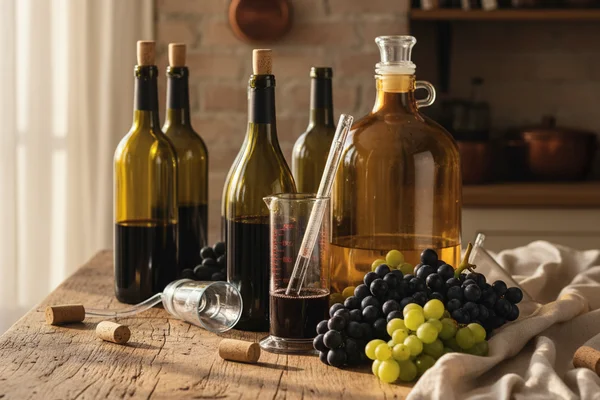
- Gather your equipment first — a fermenting bucket, airlock, siphon hose, hydrometer, and sanitizer are the core kit you’ll use for every batch you ever make.
- Measure everything — starting gravity, acid level, and volume — before you pitch your yeast, because corrections made early cost minutes while corrections made late can cost the whole batch.
- Keep notes on every batch: date, ingredients, measurements, yeast strain, and any changes you made, so you can repeat your wins and learn from your misses.
Why this works
Winemaking is microbiology with a deadline. Yeast — single-celled fungi — consume dissolved sugars and produce ethanol and carbon dioxide as byproducts. The rate and completeness of that conversion depend on three things: enough sugar to reach your target alcohol level, a pH low enough to discourage spoilage bacteria, and a healthy yeast population that isn’t stressed by temperature swings or nutrient gaps. A hydrometer tells you where your sugar stands. An acid testing kit tells you where your pH lands. Together, those two tools give you actual data instead of guesswork, and data is what separates a repeatable process from a lucky accident.
Notes
Frozen fruit works just as well as fresh for most recipes — and often better, because freezing ruptures cell walls and releases juice more freely. If a recipe calls for a specialty winemaking acid blend, plain white grape juice concentrate from the grocery store can sometimes fill the body gap in a pinch. When in doubt about a substitution, err on the side of adding less and adjusting later.